


*Spoiler warning: This recap covers major plot points from Season 1, Episode 3 of the Netflix limited series Below.*
In “Sir John Franklin,” the third episode of Jesse McKeown’s Newfoundland-set thriller, the threat facing Snook’s Arm expands from a single monstrous encounter to a spreading infection and the arrival of outsiders whose motives are far from pure. Directed by Helen Shaver and written by Perry Chafe, the roughly 40-minute installment efficiently raises the stakes while deepening the Penney family’s fractures and the scientific underpinnings of the horror.
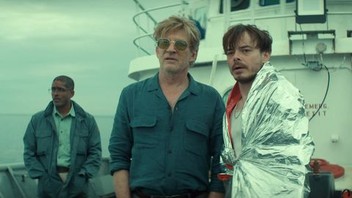
The episode opens with Wade Penney (Charlie Heaton) kayaking out to the massive iceberg that has drawn so much attention. A research vessel—the RSV *Sir John Franklin*—approaches, and he is brought aboard. There he meets commander Steve Bruner (David Wenham) and marine biologist Dr. Hugo Sayed (Alexander Karim). Wade recounts the previous night’s attack that left Jerry dead and shows the deep wound on his back. He also describes worsening symptoms: headaches, sleeplessness, and an unquenchable thirst. Steve explains that a colleague theorizes an undetected species of cephalopod whose gelatinous secretion acts like a neurotoxin, comparable to chronic wasting disease in mammals. Impressed by Wade’s local knowledge, they offer him a job guiding their mission. Wade, still seeking validation he rarely receives at home, accepts.
Meanwhile, back in Snook’s Arm, Dr. Fonda Howander (Mackenzie Davis) addresses a skeptical town meeting. She links recent deaths and strange behavior to an unusually aggressive cephalopod. Calvin Penney (Josh Hartnett) stands to corroborate her account, having seen the creature himself, but the residents remain unconvinced. Frustrated and driven by the childhood trauma of watching something take his father during a resettlement tow, Calvin decides to hunt the creature alone. His daughter Mary (Ruby Stokes) tries to stop him, and his sister Ruth (Willow Kean) goes further: she removes the engine coil from his boat. Ruth also reveals she is leaning toward voting for resettlement, a decision that further strains the family.
Calvin spots Wade aboard Steve’s vessel and pursues them in a smaller boat. On deck he confronts the newcomers, questioning the harpoon system and their “conservationist” credentials. He offers himself in Wade’s place; Wade, feeling undermined once again, storms off. Parallel family dramas unfold ashore. Jay (Rohan Campbell) is deep in debt to out-of-town creditors and schemes to collect resettlement money, while also growing closer to local official Jan Hicks (Natasha Henstridge). Mary’s boyfriend Noah grows increasingly anxious to leave and realizes a family ring is missing—stolen by Jay.
Fonda encounters Dr. Sayed as he samples the iceberg. He shares a more ominous theory: the creature is ancient, its natural Arctic habitat disrupted by warming waters, and it uses icebergs and their secretions to mark territory. He recounts historical accounts of sailors driven mad by similar toxins, driven to drown themselves. The contamination threat becomes personal when Fonda receives an alert that her research facility is in lockdown. She later finds her assistant Barry repeatedly smashing his head against a window in a desperate attempt to reach the water.
Wade’s condition continues to deteriorate—extreme thirst, disorientation, and hallucinations involving the “Old Hag” that turn unexpectedly intimate. At the local bar, ice harvested from the berg is used in drinks, and patrons begin showing signs of the same impairment. Calvin and Ruth share a tense but somewhat conciliatory drink; Jay’s creditors confront him outside, leading to a scuffle that Calvin breaks up. Realizing Steve and Wade have slipped away again, Calvin steals a boat and heads back out. The episode closes on Fonda discovering Barry’s violent, water-obsessed breakdown.
### Review
“Sir John Franklin” is one of the stronger early episodes in *Below*’s six-part run, successfully widening the mystery without losing the intimate, place-based tension that has defined the series so far. The introduction of Steve and Sayed injects both scientific credibility and institutional distrust; Wenham’s understated command and Karim’s intensity make the pair feel like credible outsiders rather than cartoonish interlopers. Their theory—that the creature is an ancient, climate-displaced apex predator marking territory with psychoactive ice—grounds the horror in ecological reality while raising the personal stakes for everyone who has already been exposed.
Heaton continues to be a standout as Wade. The infection is not just a plot device; it externalizes the character’s long-standing sense of invisibility and his hunger for purpose. Hartnett’s Calvin remains the emotional anchor, his protective instincts constantly colliding with the family’s desire to keep him (and themselves) alive. The town’s skepticism at the meeting feels authentic for a community already exhausted by economic decline and resettlement pressure, and the quiet horror of contaminated ice turning a community gathering into a vector of madness is effectively staged.
Pacing is brisk, and the episode avoids the padding that sometimes afflicts limited series. It advances both the creature mythology and the human conflicts—Jay’s debts, Ruth’s desire to leave, the Penney siblings’ complicated bond—while ending on a note of genuine dread. Critics have generally responded favorably to the series overall (87% on Rotten Tomatoes, 70 on Metacritic), praising its atmospheric restraint and thematic ambition even when later episodes shift tone. Episode 3 sits comfortably in the stronger first half, delivering the escalating dread and character work that make *Below* more than a standard sea-monster outing.
For viewers invested in the Penneys and the slow-burn mystery of what is truly “below,” this is essential viewing. The water is no longer just dangerous—it is actively rewriting the minds of those who touch it.