


Warning: Full spoilers for VisionQuest Season 1, Episode 3 (“Reboot”) follow.
After the raw sacrifice that closed “Theseus,” Vision and Thomas Shepherd are on the run in a borrowed car, with Paladin’s drones still hunting them. Vision is critically damaged from adamantium rounds and the power drain that forced J.A.R.V.I.S. to delete himself to keep the other AIs—and Vision—online. Inside the mindscape, the remaining programs (E.D.I.T.H., D.U.M.-E., U., and a newly freer Ultron) scramble to stabilize systems that are failing fast. A full reboot may be the only path forward, but it is dangerous, incomplete without J.A.R.V.I.S.’s processing power, and emotionally fraught.
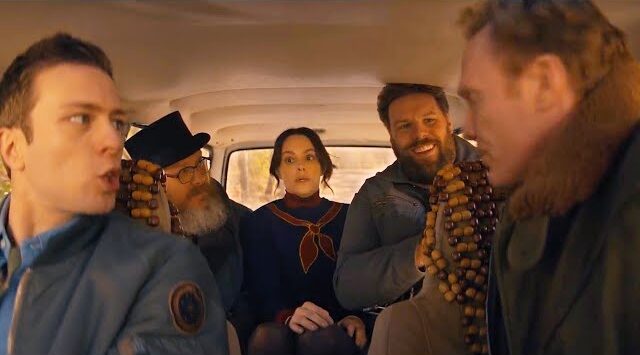
The episode intercuts the chase with painful origin stories. Thomas finally articulates why water terrifies him: when Tommy Maximoff’s consciousness entered his body years earlier, he was being held under in a swimming pool. His vibrating speed boiled the water and injured people around him. The trauma fused two lives and left him with abilities he cannot fully control—and a deep distrust of the man who claims (or refuses to claim) fatherhood. In the car, their argument turns raw. Vision insists any parental claim would belong to Wanda Maximoff, not him; Thomas refuses to drive another mile without answers about who he is. The AIs interrupt with comic timing and warnings about approaching drones, underscoring how crowded Vision’s head has become.
Paladin’s backstory receives equal weight. We see a younger version of the bounty hunter raised by an abusive father who is then executed by a previous Paladin—revealing a multi-generational lineage of killers rather than a single mercenary. The present-day Paladin is later told he is “not a true Paladin, merely raised by one.” Meanwhile, London headlines track the “Butcherbird Killer,” a grotesque serial murderer who plucks out victims’ eyes and carves wings into the floor. The thread links to stolen adamantium and the larger hunt for Vision, while a mysterious force briefly invades and appears to possess the synthezoid—his eyes glowing red as he levitates in a classic horror beat.
Practical survival mixes with the absurd. Vision cauterizes a wound with sulfuric acid in a brutal sequence. Thomas’s powers glitch at a vending machine, phasing his hand into the glass and cutting himself when he pulls free. Ultron, ever the sarcastic devil on the shoulder, suggests they watch a “porno” amid the crisis. The episode builds toward a hotel swimming pool where Vision must coach Thomas through the reboot process—precisely the element that terrifies the young man most.
“Reboot” is where VisionQuest begins converting its premise into genuine emotional progress. Paul Bettany gets more to play than the cold, memory-rich but feeling-poor White Vision of the first two episodes. Malfunctioning processors give him physical comedy without undercutting the drama, and the deepening bond with Ruaridh Mollica’s Thomas/Tommy feels earned rather than rushed. By the time Vision is guiding his son through the pool reboot, the show has started closing the gap between the original Vision’s humanity and this version’s emptiness.
James Spader’s Ultron remains a highlight—less dominant than in the premiere but still delivering sharp observations and dark humor that contrast with the AIs’ more earnest efforts (Orla Brady’s F.R.I.D.A.Y., Emily Hampshire’s E.D.I.T.H., and the others). The supporting programs continue to humanize material that could have stayed purely conceptual. Direction by Gandja Monteiro and the script keep the dual timelines and internal voices legible, though the shift toward a new threat (including T’Nia Miller’s Jocasta) feels slightly abrupt after Paladin’s intensity.
The episode is not flawless. Content is grim—acid cauterization, eye-gouging implications, childhood trauma, and a brief possession sequence—and some world-building (the Butcherbird, the Paladin lineage) expands the canvas without fully resolving it yet. Still, the father-son core lands. Vision is learning to act protectively even when the feelings lag behind the actions, and Thomas is forced to confront the dual identity that has made ordinary life impossible.
For a series that opened with a deliberately distant protagonist, “Reboot” is a meaningful step forward. It treats identity, inheritance, and artificial family with more texture than the typical MCU mystery-box setup, and Bettany’s performance sells the fragile progress. The double drop with “Malware” suggests the second half of the season will escalate the external threats, but this hour’s strength is internal: a damaged machine and a traumatized young man figuring out whether they can reboot something worth saving together.