


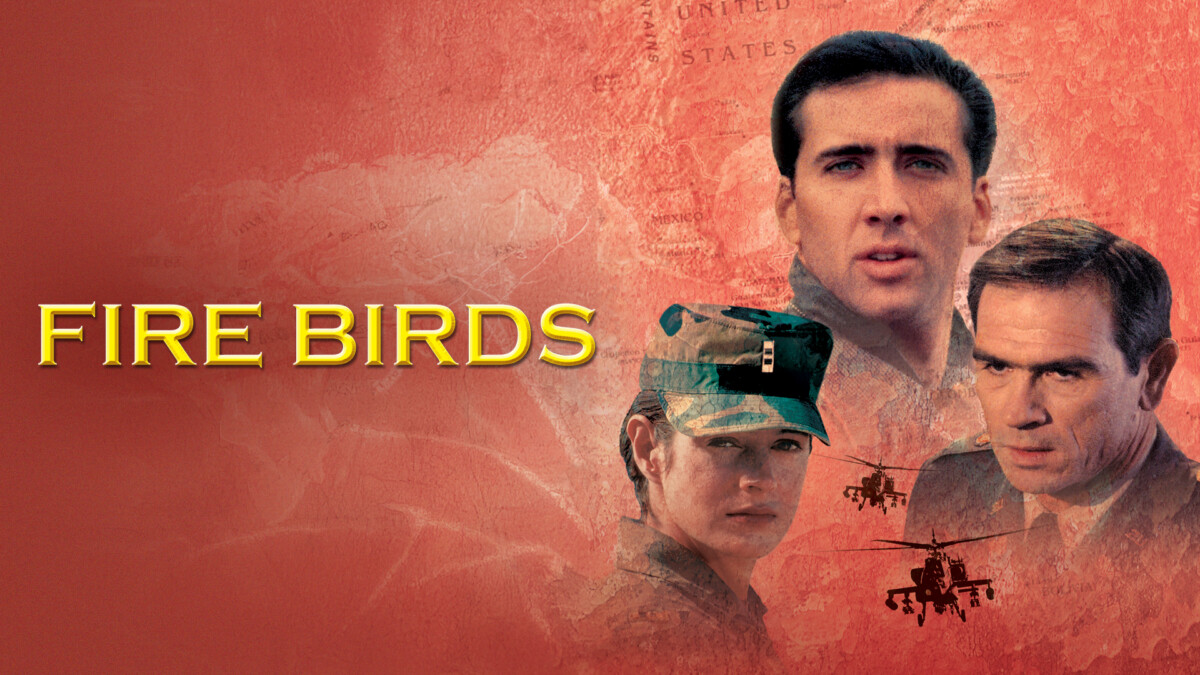
In the long shadow of Top Gun and its recent legacy sequel, Fire Birds (also known in some markets as Wings of the Apache) has always been the most transparent and least successful of the late-’80s/early-’90s aviation imitators. Released in May 1990 and directed by David Green, it swaps Tom Cruise’s F-14 for the then-new AH-64 Apache and replaces Cold War Soviets with South American drug cartels. Revisiting it in 2026, the film remains exactly what it was on arrival: a brisk, hardware-obsessed, thoroughly formulaic piece of military-flavored pulp that never rises above its transparent ambitions.
Nicolas Cage stars as Jake Preston, a cocky U.S. Army attack-helicopter pilot and sole survivor of a disastrous raid on a cartel compound. The cartel’s edge is a skilled mercenary pilot named Eric Stoller (Bert Rhine) flying a highly modified MD 500 dubbed the “Scorpion.” The Army’s answer is to stand up a small force of Apaches for air-to-air work. Preston is sent into an accelerated training program under the gruff, motivational instructor Brad Little (Tommy Lee Jones) and is reunited with his former girlfriend, Billie Lee Guthrie (Sean Young), a Kiowa scout-helicopter pilot assigned as a spotter. Preston also has to overcome an eye-dominance problem that complicates his use of the Apache’s helmet-mounted display—an obstacle the film treats with the same earnestness it brings to every other training montage.
The movie opens with a text quote from President George H.W. Bush about taking the drug war to the source, and that late-Reagan/Bush-era confidence never leaves the screen. The script (credited to multiple writers including military advisor Dale Dye) is pure boys-to-men aviation drama: the hotshot with a personal hang-up, the tough mentor who sees the pilot’s potential, the female aviator who must prove herself, and a final dogfight that settles both the professional and romantic scores. At 86 minutes it moves quickly, and the production had real Army cooperation, so the Apaches themselves look formidable and the aerial work has a tangible weight that pure CGI cannot fake.
What does not hold up is almost everything around the hardware. Contemporary reviews were largely negative (Rotten Tomatoes has hovered in the low teens to low twenties; Metacritic sits at 31), and the same problems are more obvious now. The dialogue is frequently on-the-nose or outright silly; character relationships are sketched rather than developed; and the romance between Cage and Young never generates much heat. Young’s role is particularly underwritten. Jones, as usual, is the most watchable person on screen, delivering the mentor lines with dry authority that almost makes the clichés land. Cage, still a few years away from the full intensity of his mid-’90s action peak, brings restless energy but is constrained by a script that wants a conventional leading man more than a distinctive one. The aerial sequences, while better than nothing, were already criticized in 1990 for looking confusing or video-game-like compared with Top Gun; modern eyes accustomed to clearer geography and more dynamic camera work find them even less thrilling.
The film’s politics also feel like a time capsule. The cartel is a faceless evil, the solution is elite military hardware and pilot skill, and moral complexity is absent. That was already simplistic in 1990; in 2026 it plays as pure period artifact. The movie does not age into unintentional comedy the way some of its more extreme contemporaries do, nor does it earn genuine suspense or emotional investment. It is simply competent enough in its narrow lane to finish without collapsing.
Does it stand up? As a serious action film or as a meaningful companion to Top Gun, no. As an 86-minute curiosity for Nicolas Cage completists, Tommy Lee Jones fans, or anyone who enjoys the particular flavor of early-’90s military recruitment cinema, it is harmless and occasionally diverting. The real Apaches still photograph well, Jones remains a pleasure, and the runtime is merciful. Everything else is as lightweight and derivative as the reviews said the first time around. Fire Birds never quite took flight, and time has not given it wings… but it does have some great one-liners.