


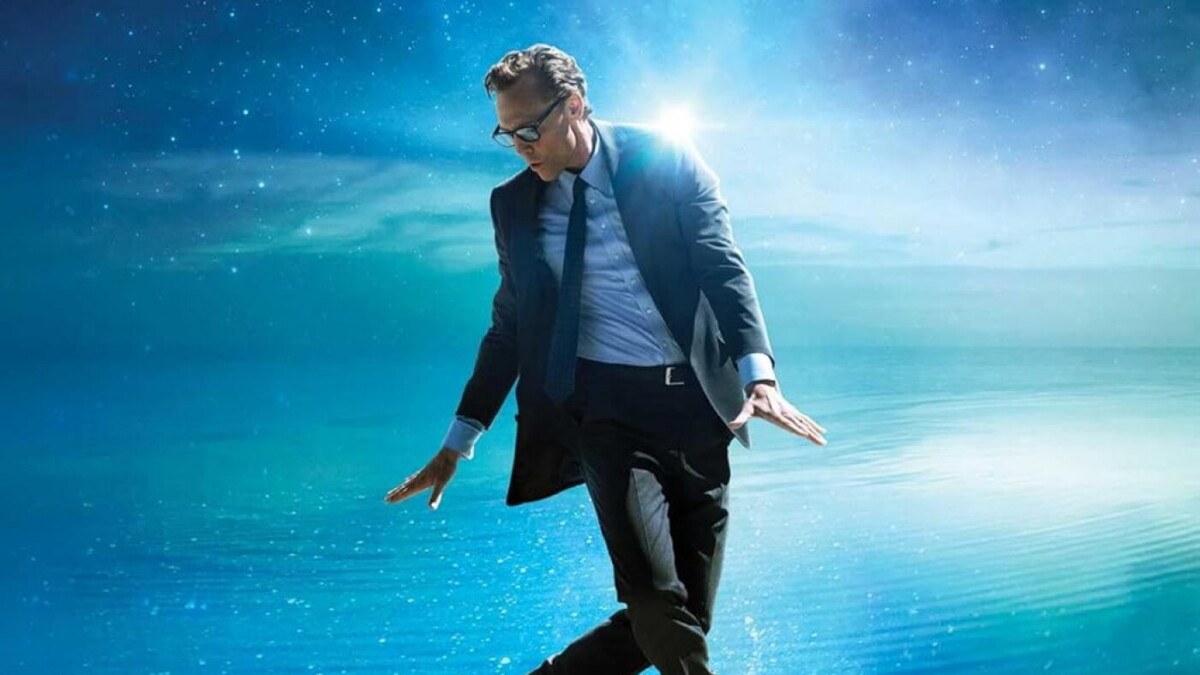
In a film landscape crowded with franchises and familiar scares, Mike Flanagan’s The Life of Chuck stands apart as a tender, structurally daring celebration of ordinary existence. Adapted from Stephen King’s 2020 novella (from the collection If It Bleeds), the film unfolds in reverse across three acts, beginning at the apparent end of everything and working backward through the life of Charles “Chuck” Krantz. It is not horror in the conventional sense—Flanagan, the filmmaker behind The Haunting of Hill House, Doctor Sleep, and Gerald’s Game, largely sets aside the macabre here—but it carries King’s characteristic empathy and a cosmic curiosity about what a single human life contains.
The story opens amid escalating catastrophe: natural disasters, the collapse of the internet, and a world fraying at the edges. Schoolteacher Marty Anderson (Chiwetel Ejiofor) and nurse Felicia (Karen Gillan) navigate the chaos while mysterious billboards and screens everywhere thank an unknown man named Chuck for “39 great years.” What follows is a puzzle that gradually reveals itself as a portrait of one man’s life—his loves, losses, small joys, and the quiet multitudes within him. Tom Hiddleston plays the adult Chuck, an accountant whose most memorable moment arrives in a spontaneous, joyous street dance with a stranger (Annalise Basso) to the beat of a busking drummer. Younger versions of Chuck are portrayed by Benjamin Pajak, Jacob Tremblay, and others, with Mark Hamill and Mia Sara as the grandparents who shape him. Nick Offerman’s narration provides a wry, grounding voice throughout.
Flanagan, who also wrote and edited the film, stays remarkably faithful to King’s source material while making the reverse structure cinematic. The result is both intimate and expansive: every life is framed as its own universe, echoing Walt Whitman’s line that we “contain multitudes.” When that life ends, the universe it holds ends with it. The idea is simple yet profound, and the film’s emotional power rests on how ordinary Chuck is—an Everyman who loves dancing and numbers, shaped by family, tragedy, and the choice to keep living fully. Hiddleston brings warmth and a subtle melancholy to the role, making the dance sequence feel like pure, unforced life rather than a set piece. Hamill, in particular, has drawn widespread praise for his grounded, affectionate turn as Chuck’s grandfather.
Critical reception has been largely positive. The film holds an 80% on Rotten Tomatoes (with an average of 7.5/10) and a 67 on Metacritic, with the Rotten Tomatoes consensus calling it “a buoyant and often wonderful adaptation of one of Stephen King’s more cosmically optimistic tales.” It won the People’s Choice Award at the 2024 Toronto International Film Festival, a strong early signal of audience affection. Not every critic is fully sold—some find the structure disjointed or the sentimentality a touch maudlin, and the third act (chronologically the beginning) can feel more conventional after the mystery of the opening. Box office was modest (roughly $21 million worldwide against an estimated $25 million budget), a reminder that unconventional storytelling still faces commercial headwinds even when it earns strong notices and later finds an audience on streaming.
At 111 minutes, The Life of Chuck is neither sprawling nor rushed. It asks viewers to trust its backward logic and sit with the idea that small moments—a dance on a sidewalk, a conversation with a teacher, the quiet inheritance of a family’s habits—can hold the weight of the world. For fans of King’s non-horror work (think the emotional core of The Shawshank Redemption or Stand by Me) and for anyone drawn to stories about living deliberately, it is a rewarding and frequently moving experience. Flanagan has made something gentle and ambitious: a reminder that the end of one universe does not diminish the wonder of the life that created it.
The Life of Chuck is available on various streaming platforms following its 2025 theatrical run.