


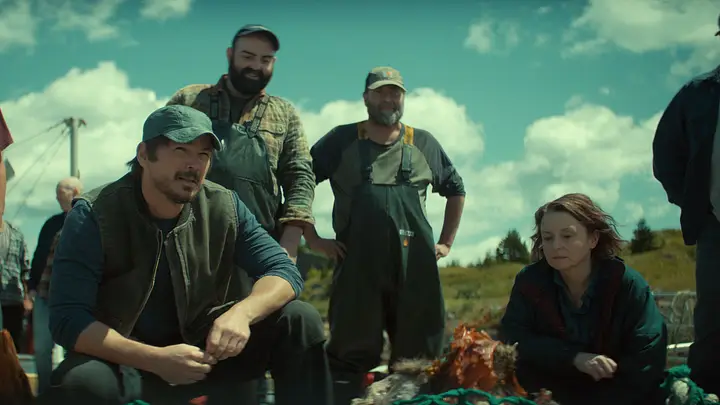
Netflix’s limited series Below continues its atmospheric Newfoundland-set thriller in Episode 2, “Crown and Anchor.” After the shocking close of the premiere, the hour leans further into mystery, psychological unease, and local folklore while advancing the central threat lurking in the waters around Snook’s Arm. Directed by Jamie Childs and written by creator Jesse McKeown, it prioritizes character tension and mounting unease over nonstop set pieces, effectively raising the stakes for Calvin Penney (Josh Hartnett) and his family.
Spoiler warning: The following contains major plot details from Episode 2.
The episode opens amid the ongoing search for Jerry Biles and the remains of his boat. A diver works in near-zero visibility while recovery crews pull wreckage ashore. Calvin watches the floating debris and is flooded with memories of the day decades earlier when his family’s house sank during a resettlement, claiming his father’s life. The official theory—that Jerry became tangled while trying to haul a chunk of iceberg—fails to convince him. When a partially digested moose head surfaces in a net, the possibility of something far larger and more predatory becomes harder to dismiss.
Back at the Penney house, Wade (Charlie Heaton) is recovering from his near-fatal encounter. He drinks water in alarming quantities, sketches the circular form he saw in the water, and seems altered—calmer yet distant. Calvin discovers circular marks resembling sucker impressions across Wade’s back and takes the photo to marine biologist Dr. Fonda Howander (Mackenzie Davis). She connects the pattern to cephalopods, specifically giant squid (Architeuthis dux), and shares data on vanishing fish stocks and emptied farms along the Labrador coast, pointing to broader oceanic disruption. Calvin remains skeptical that a squid would behave so aggressively near humans, but the conversation forces him to reconsider the official account of his father’s death.
Elsewhere, a worker at a local fish operation is pulled under by something with long tentacles. Calvin and Fonda later visit Pittman’s site and locate the campsite used by the Penneys’ Airbnb guests. They find a torn tent and scattered body parts; security footage later shows tentacles dragging both a moose and people into the water. Family pressures continue in parallel: Mary (Ruby Stokes) and Jay (Rohan Campbell) debate resettlement money and their father’s stubborn refusal to leave; Jay faces escalating threats from people he owes; and Noah prepares to propose to Mary at the ongoing Come Home Year garden party while fretting over a missing ring. Ruth (Willow Kean), serving as harbormaster, pushes through exhaustion coordinating the search before being ordered to rest.
Wade’s recovery takes a stranger turn when he experiences a vivid encounter with a drowned woman—described as looking like a “drowned rat”—who appears both in a nightmare and, seemingly, in his room. Jay attributes it to stress and the Old Hag, a traditional Newfoundland explanation for sleep paralysis, and offers folk remedies. Wet footprints on the floor after Jay leaves suggest the experience may not have been purely internal. Calvin arrives at the garden party and urgently warns everyone away from the water, appearing unhinged to those who haven’t seen the evidence. Authorities call off the search for the Portuguese vessel Santa Christina and its missing crew, declaring them presumed dead. The episode closes on a grim image: a one-legged man (apparently one of the Portuguese sailors) restrained in a room, with wet, dirty feet belonging to a standing figure nearby.
“Crown and Anchor” successfully expands the series’ tone from straightforward creature-feature tension into something that incorporates psychological and folkloric elements without losing its grounded sense of place. The Newfoundland setting remains a strength: the close-knit community dynamics, the practical pressures of a dying fishing economy, the resettlement debate, and the Old Hag folklore all feel specific rather than generic. Hartnett continues to ground the material as a weary, guilt-burdened fisherman whose past trauma is colliding with present danger, while Heaton effectively conveys Wade’s disorientation and physical aftereffects. Davis’s Fonda provides a clear-eyed scientific counterpoint that keeps the escalating weirdness tethered to investigation rather than pure supernatural speculation.
The episode’s deliberate pacing favors conversation, aftermath, and implication over constant action, which some viewers may find slow. Yet the quieter stretches allow the dread to accumulate effectively—particularly around Wade’s altered state, the unexplained thirst and marks, the vanishing marine life, and the Old Hag sequence. The folklore integration is smart: by invoking a real regional tradition associated with sleep paralysis, the show creates ambiguity about whether Wade is experiencing residual trauma, something chemical from the ice or water, or an external presence. The final image of the captive sailor and the wet feet is an effective, unsettling button that raises fresh questions about how the various threats connect.
Supporting threads (Jay’s debts, the resettlement vote, Noah’s proposal plans) add texture to the family and community stakes, though they risk feeling secondary until they more fully intersect with the central mystery. Visually and atmospherically, the hour maintains the chilly, isolated mood established in the premiere, with the water remaining a constant source of unease.
Overall, “Crown and Anchor” is a strong transitional episode that deepens the mystery, sharpens the family conflicts, and introduces folkloric elements that complicate the creature threat. It rewards patience with mounting dread and a richer sense of the world, setting up the series’ later revelations about the true nature of what is in the water and the people still connected to the town’s past. For viewers drawn to the blend of family drama, ecological undercurrents, and coastal horror, it continues to deliver.