


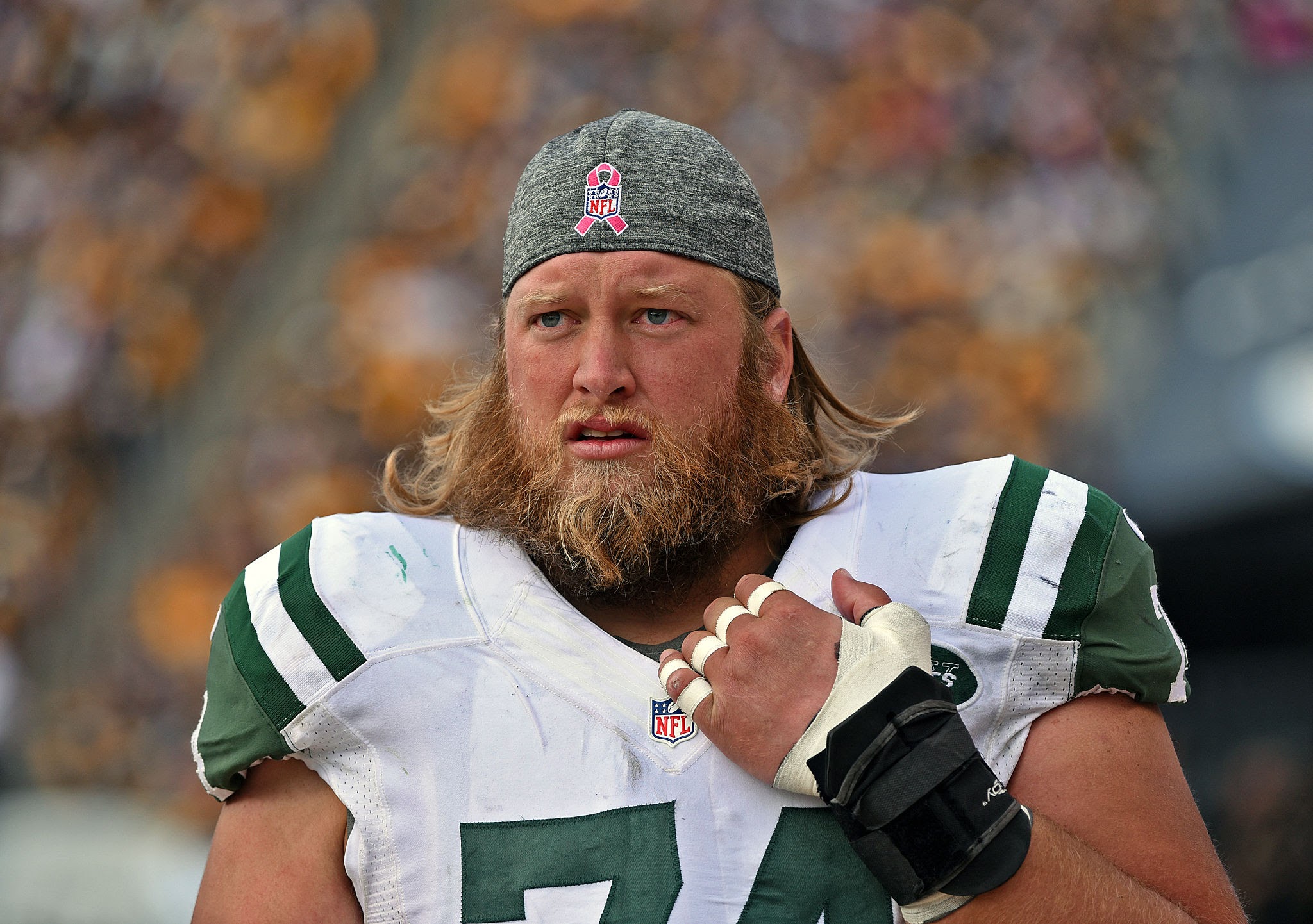
In a heartbreaking loss for the New York Jets and the broader NFL community, former All-Pro center Nick Mangold has died at the age of 41. The Jets organization announced the news Sunday morning, revealing that Mangold passed away Saturday night from complications related to chronic kidney disease. His death comes just two weeks after he publicly shared his battle with the illness and appealed for a kidney donor, a plea that touched fans and former teammates alike.
Mangold, who retired from the NFL in 2016 after a stellar 11-year career spent entirely with the Jets, was diagnosed with a genetic kidney defect in 2006—the same year he entered the league as a first-round draft pick out of Ohio State. Despite the condition, he played through it without missing a beat, becoming one of the most durable and respected linemen of his generation. “Nick was the heart and soul of our offensive line,” Jets owner Woody Johnson said in a statement. “His toughness on the field was matched only by his kindness off it. We are devastated.”
Selected fifth overall in the 2006 NFL Draft, Mangold quickly established himself as the anchor of the Jets’ offensive line. Over his tenure in green and white, he earned seven Pro Bowl selections, two First-Team All-Pro honors, and was a key part of the teams that reached consecutive AFC Championship Games in 2009 and 2010. His blocking prowess protected quarterbacks like Chad Pennington, Brett Favre, Mark Sanchez, and Geno Smith, helping to pave the way for running back Thomas Jones’ 1,000-yard seasons and contributing to the Jets’ reputation for a gritty, physical ground game.
Off the field, Mangold was equally impactful. He hosted the podcast “The Nick Mangold Show,” where he interviewed fellow athletes and shared insights on leadership and resilience. His charitable work, including support for children’s hospitals and veterans’ causes, earned him the NFL’s Walter Payton Man of the Year nomination in 2012. “Nick wasn’t just a great player; he was a great man,” said former Jets quarterback Mark Sanchez in a social media post. “He taught me what it means to show up every day, no matter what.”
Mangold’s post-retirement life kept him connected to the sport he loved. He served as a color commentator for Jets broadcasts and remained an active voice in NFL discussions, often advocating for player health and wellness—ironically, topics that would later resonate deeply with his own health struggles.
Mangold’s health challenges became public knowledge in early October when he posted an emotional letter on social media, explaining his need for a living kidney donor. “In 2006, I was diagnosed with a genetic defect that has led to chronic kidney disease,” he wrote. “Now, it’s time to ask for help.” The response was overwhelming: Fans organized donor drives, and former teammates like D’Brickashaw Ferguson and Damien Woody publicly offered support and urged others to get tested.
Tragically, time ran out before a match could be found. “We are grateful for the outpouring of love and the many who stepped up to help,” the Mangold family said in a statement released through the Jets. “Nick fought with the same grace and determination he brought to every snap.”
The news of Mangold’s passing spread like wildfire, eliciting an avalanche of condolences. NFL Commissioner Roger Goodell called him “a model of excellence and perseverance,” while Hall of Fame center Mike Webster’s family remembered him as a “worthy successor to the greats.
Current Jets center Joe Tippmann, who wore No. 77 in Mangold’s honor during his rookie year, posted: “You were my idol, my mentor, my friend. Rest easy, big man.” The team plans to honor Mangold with a moment of silence before their next home game and a permanent display in the Ring of Honor at MetLife Stadium.
Nick Mangold leaves behind his wife, Kathryn, and their two young children, as well as a brother, Jake, who followed in his footsteps as an NFL lineman. Born in Ohio and raised in a family of athletes, Mangold’s life was one of quiet leadership—on the gridiron, in the broadcast booth, and in his final days, facing adversity with unflinching courage.
As the Jets and the NFL mourn, Mangold’s story serves as a poignant reminder of the fragility of life, even for those who seem unbreakable. His No. 74 jersey may never be retired, but his impact on the game—and the people who loved it—will endure forever.
The Jets organization has directed memorial donations to the National Kidney Foundation in Mangold’s name.