


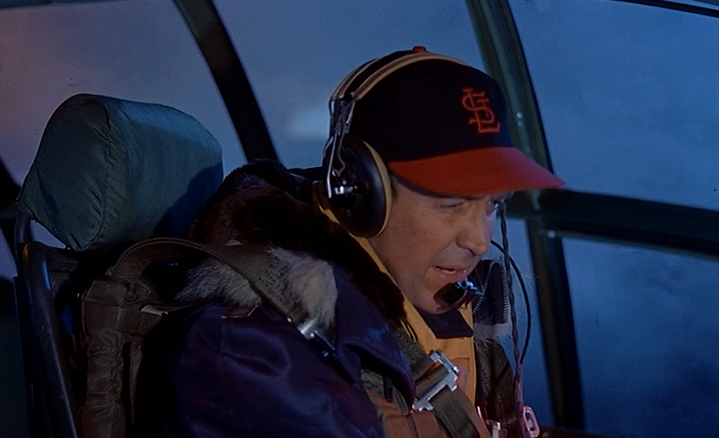
Anthony Mann’s 1955 Technicolor drama Strategic Air Command is a product of its Cold War moment, but it also happens to be one of the few major Hollywood films to put a St. Louis Cardinals player at its center. James Stewart plays Robert “Dutch” Holland, a third baseman enjoying spring training in Florida when an old wartime buddy arrives with orders recalling him to active duty. The baseball sequences were shot with the cooperation of the Cardinals at their St. Petersburg camp, giving the early scenes an authentic diamond texture that still lands for anyone who follows the club.
Holland is a former B-29 pilot and reservist whose civilian life—newly married to Sally (June Allyson) and established as a big-league regular—is interrupted for the needs of the Strategic Air Command. What follows is less a conventional war story than a portrait of readiness: long-range deterrence flights in the massive Convair B-36 Peacemaker, transition to the jet-powered B-47, and the personal cost of months spent away from home and the game. Stewart, himself a wartime bomber pilot who remained active in the Air Force Reserve and later rose to brigadier general, brings unmistakable credibility to the cockpit work. He did not need coaching on how a man who had flown combat missions would carry himself among the new generation of strategic bombers.
The film’s lasting value lies primarily in its aerial photography. Shot in VistaVision, the sequences of B-36s and B-47s in flight remain impressive; the aircraft effectively become co-stars. Critics at the time were cooler on the domestic drama and supporting performances, describing the picture as more recruitment-adjacent than fully realized drama, yet audiences responded to the spectacle and the clear sense of purpose. The picture performed solidly at the box office and even coincided with a reported uptick in Air Force enlistments. Modern viewers will notice the straightforward patriotism and the limited complexity of the personal conflict, but the combination of Stewart’s grounded presence and the genuine hardware still carries weight.
For a site that covers both movies and the Cardinals, the film offers a specific point of intersection. Holland is not a generic athlete; he is explicitly a Cardinals third baseman whose return to the majors is placed in doubt by the physical demands of the flying. Jay C. Flippen appears as the club’s manager, and the spring-training setting anchors the story in the everyday rhythms of baseball before the larger Cold War machinery takes over. The result is a period piece that simultaneously documents mid-1950s air power and briefly captures the look and feel of Cardinals spring training of that era.
Strategic Air Command is not a deep character study, nor does it pretend to be. It is a professionally mounted, visually striking document of its time, elevated by Stewart’s authenticity and the still-compelling footage of the bombers that defined the early nuclear deterrent. Cardinals fans curious about the era—or anyone interested in how Hollywood portrayed the intersection of professional sports and military service in the 1950s—will find it worth revisiting.