


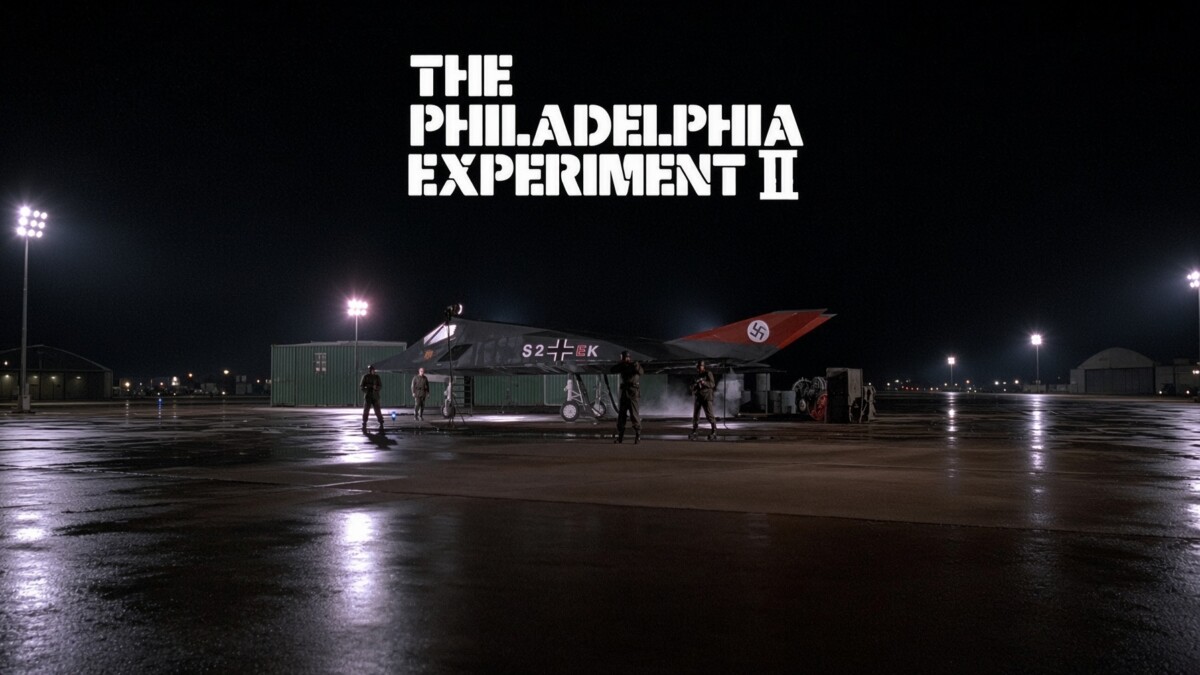
Nine years after sailor David Herdeg was flung from 1943 to 1984 in the first film, he’s settled into a struggling single-dad life in 1993 California (his wife Allison has died). A new government project involving a teleportation device for a stealth bomber goes sideways. The plane is sent back to 1943 Nazi Germany, where it is used to nuke Washington, D.C. and help the Nazis win World War II. David is yanked into this grim alternate 1993 under decades of Nazi rule. He teams up with a resistance fighter (Marjean Holden) and must exploit his unique connection to the original experiment to go back and stop the plane before history is permanently rewritten.
Brad Johnson takes over the Michael Paré role as David. He’s serviceable but stiff and low-charisma, which undercuts the emotional stakes around his son and the timeline. The real spark comes from Gerrit Graham in a dual role as both the modern-day megalomaniacal scientist William Mailer and his Nazi-era father. Graham leans into the campy villainy without tipping fully into parody, and it’s the most entertaining element of the film. The supporting cast is adequate for the material, and the production design of the Nazi-occupied America has a gritty, low-rent Orwellian feel that fits the budget.
The concept is the strongest part. The “Nazis won because of a time-displaced stealth bomber” hook has pulp-sci-fi appeal, and the film occasionally delivers on the dystopian atmosphere and the time-paradox mechanics. There are moments of solid action and a few clever timeline wrinkles. Director Stephen Cornwell keeps things moving in the second half, and the 97-minute runtime doesn’t overstay its welcome too badly.
Where it falters is almost everywhere else. The budget shows in the effects and staging. The pacing is uneven—especially early on—and the script prioritizes straightforward action over exploring the moral or personal consequences of rewriting history. Johnson’s flat performance drains urgency from scenes that should feel high-stakes. Compared with the original’s fish-out-of-water charm and stronger lead, this one feels like a cash-in that doesn’t fully capitalize on its premise. Contemporary critics (including Variety) called it middling, and audience scores have stayed low (around 4.5/10 on IMDb).
It’s the kind of early-’90s B-movie that plays best with lowered expectations: fun for fans of alternate-history sci-fi or the original film, but not essential. The grandfather-paradox resolution and the slightly sappy coda give it a modest emotional button, yet the journey there is too generic to stand out.