


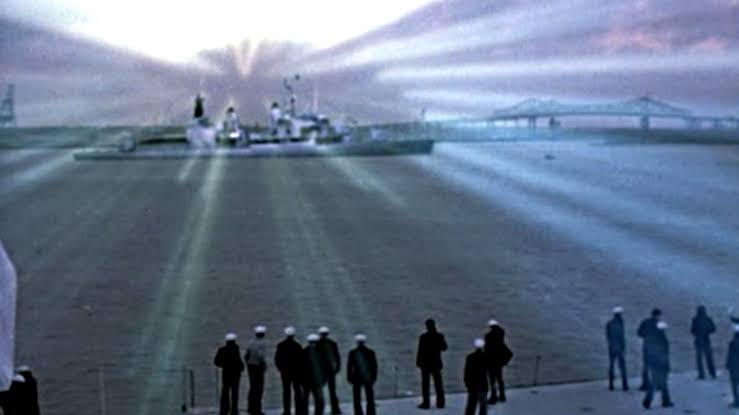
More than forty years after its release, The Philadelphia Experiment remains a curious artifact of 1980s science fiction—one that blends the era’s practical effects and earnest storytelling with one of the most enduring military urban legends of the 20th century. Directed by Stewart Raffill and executive-produced by John Carpenter, the film takes the alleged 1943 U.S. Navy experiment involving the USS Eldridge and transforms it into a time-displacement adventure that still holds a modest cult appeal.
In 1943, sailors David Herdeg (Michael Paré) and Jim Parker (Bobby Di Cicco) are aboard a destroyer escort during a top-secret attempt to render the ship invisible to radar. The experiment goes catastrophically wrong, hurling the two men forward to 1984. Disoriented in a world of color television, modern cars, and Cold War tensions, they must navigate a military cover-up while racing to prevent a new experiment from tearing open a dangerous temporal rift. Nancy Allen co-stars as Allison Hayes, a civilian who becomes entangled in their struggle, while Eric Christmas portrays the scientist whose work links the two eras.
The film’s greatest strength is its premise. The real-world Philadelphia Experiment legend—popularized by Charles Berlitz and William L. Moore’s 1979 book—has long fascinated conspiracy theorists with claims of invisibility, teleportation, and horrific side effects. Raffill’s version treats the story less as pure horror and more as a fish-out-of-water adventure with romance and high-stakes science. Carpenter, who had written an early draft but walked away after struggling with the third act, remained involved as executive producer. The final script, shaped by multiple writers including Michael Janover and William Gray, adds a romantic throughline that gives the time-lost sailor an emotional anchor in 1984.
Paré delivers a solid lead performance as the everyman sailor thrust into an incomprehensible future. His confusion and growing determination feel grounded, even as the plot grows increasingly fantastical. Allen, a reliable presence in 1980s genre fare, brings warmth and agency to Allison, though the romance sometimes feels more obligatory than organic. Supporting turns from Di Cicco and Christmas add texture, and early-career appearances by character actors such as Stephen Tobolowsky add flavor.
Visually, the film is a product of its time. The practical effects—electrical arcs, glowing energy fields, and the occasional melted or phased body—have a tactile quality that modern CGI often lacks, even if they occasionally look dated. Kenneth Wannberg’s score underscores the tension without overwhelming the quieter moments of cultural dislocation. Raffill, who also rewrote portions of the script to emphasize the human element over dense exposition, keeps the pacing brisk at 102 minutes, favoring chase sequences and escalating stakes over deep scientific explanation.
Critics were mixed upon the film’s August 1984 release. It currently sits at roughly 50% on Rotten Tomatoes and a Metacritic score of 44, with contemporary reviews praising the intriguing concept while noting script unevenness and a third act that leans heavily on familiar sci-fi tropes. Commercially, it earned just over $8 million against a $9 million budget—respectable for New World Pictures but far from a breakout hit. A 1993 sequel and a 2012 Syfy remake (which also featured Paré in a different role) followed, but neither matched the original’s modest cult following.
Viewed in 2026, The Philadelphia Experiment feels less like a lost masterpiece and more like a charming, slightly rough-edged entry in the wave of 1980s time-travel and conspiracy thrillers. Its strength lies in the disorientation of two WWII sailors confronting the 1980s, a fish-out-of-water element that still plays effectively. The film never fully capitalizes on the darker implications of the legend, and some plot mechanics strain credibility. Yet the central hook—what if a wartime experiment created an irreversible tear between eras?—remains compelling.
For viewers who first encountered it on late-night television or home video as kids, the film retains a nostalgic glow. New audiences may find it uneven, but those who appreciate practical-effects-era science fiction, military conspiracy yarns, or the specific charm of mid-1980s genre filmmaking will still find an adventure worth revisiting. It is not among the decade’s finest science-fiction offerings, but it remains a memorable, sincere attempt to dramatize one of America’s most persistent wartime mysteries—an experiment that, in cinematic form at least, is still going on.