


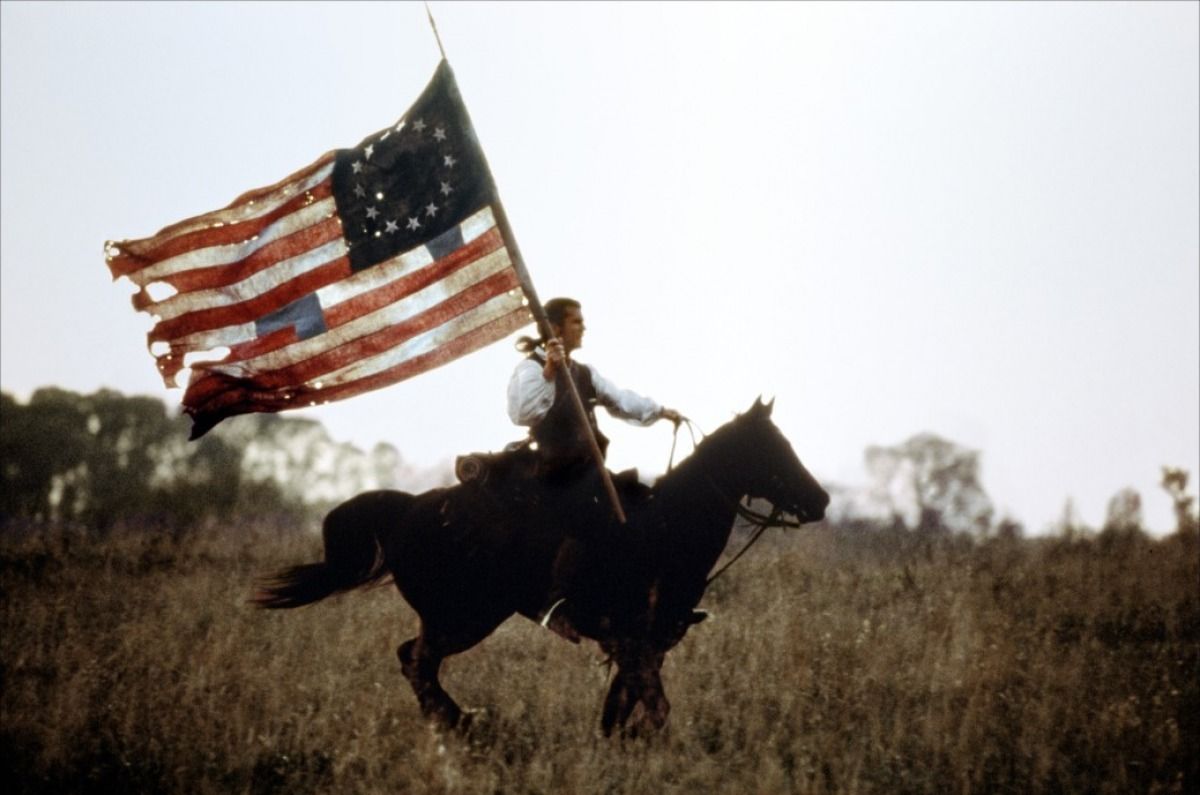
Roland Emmerich’s 2000 film The Patriot remains one of the most emotionally direct and visually muscular treatments of the American Revolution ever made. Revisited in 2026, it stands as a highly effective piece of Hollywood myth-making whose strengths in performance, family drama, and battlefield spectacle largely survive the passage of time — provided one approaches it as fiction rather than history.
The story centers on Benjamin Martin (Mel Gibson), a widowed South Carolina planter and veteran of the French and Indian War who has sworn off fighting. When the colony votes to support the Continental Army, his eldest son Gabriel (Heath Ledger) enlists against his father’s wishes. Years later, the war arrives at the Martin farm. A wounded Gabriel returns carrying dispatches, only for the ruthless Colonel William Tavington (Jason Isaacs) and his Green Dragoons to appear. Tavington executes the Martins’ young son Thomas, burns the house, and takes Gabriel. The personal catastrophe transforms the reluctant father into a guerrilla leader who organizes militia, harasses British forces under Lord Cornwallis (Tom Wilkinson), and ultimately confronts Tavington in a climactic battle loosely modeled on Cowpens. The film ends with the family’s rebuilt homestead and a nod to the eventual American victory at Yorktown.
What still works is the emotional engine. Gibson’s performance grounds the film in a father’s grief and controlled rage rather than pure ideology; the early sequences of him trying to protect his children before the war destroys that insulation remain the movie’s strongest. Ledger, in one of his first major roles, brings youthful idealism that contrasts effectively with Gibson’s weariness. Isaacs is a superb antagonist — cold, precise, and legitimately threatening — while John Williams’ score and the large-scale action (especially the ambush and final battle) deliver the visceral payoff audiences expect from Emmerich. The film’s nearly three-hour length is felt, yet the central relationship between Benjamin and Gabriel keeps the personal stakes clear amid the broader campaign.
Where The Patriot has aged less gracefully is in its relationship to history and its moral framing. Benjamin Martin is a composite of figures including Francis Marion, Thomas Sumter, and Daniel Morgan, none of whom match the film’s sanitized portrait. Most consequentially, the movie presents Martin’s Black workers as free laborers who voluntarily fight alongside him — an arrangement historians have called historically implausible for a South Carolina planter of the era. Spike Lee publicly condemned the film at the time as a whitewashing of slavery; that criticism has only grown more pointed with greater public attention to the Revolution’s contradictions. The infamous church-burning sequence, in which Tavington locks civilians inside and sets the building alight, has no documented parallel in the Revolutionary War and was widely criticized (including by British observers) as an invention that echoes later atrocities more than 18th-century British practice. Real British officers such as Banastre Tarleton were harsh and controversial, particularly after the Waxhaws, but the film’s depiction of near-uniform cartoonish cruelty simplifies a complex civil conflict in which Loyalists, Patriot atrocities, and mutual brutality all existed.
In a 2026 viewing, these choices register more clearly. The film’s power derives precisely from its refusal of nuance: it is a revenge story dressed in period clothing, not a balanced portrait of the Southern campaign. That does not erase its craft or its ability to generate genuine feeling, but it does limit its claim to seriousness as history. Mel Gibson’s subsequent personal controversies also cast a longer shadow over the “righteous avenger” archetype he perfected here and in Braveheart, though the performance itself remains committed and effective on its own terms.
The Patriot still functions well as popular entertainment — a rousing, violent, family-centered war picture with memorable set pieces and a clear moral arc. It is less persuasive as an account of the Revolution. For viewers who want the emotional impact of a father driven to arms and the spectacle of 18th-century combat rendered on a large scale, it continues to deliver. Those seeking historical fidelity or a more complicated view of the founding era will find the film’s choices increasingly difficult to overlook. Twenty-five years on, it endures as a successful piece of mythic cinema rather than a reliable window into the war it depicts.