


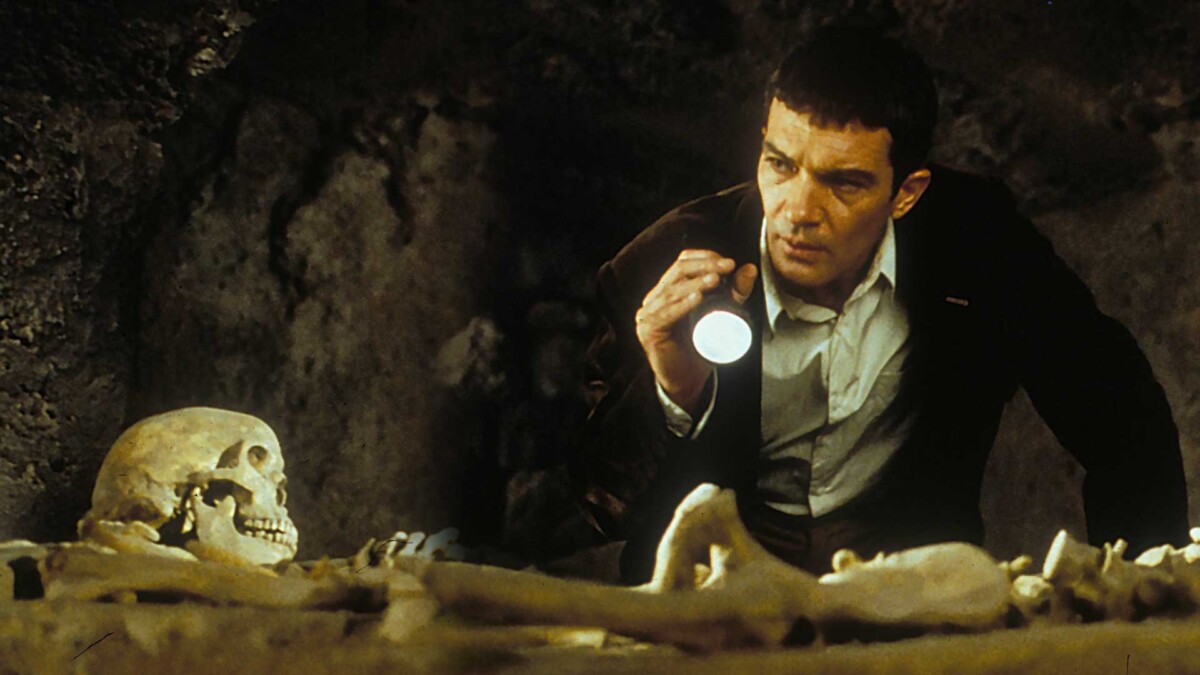
Jonas McCord’s The Body opens with a premise so charged it practically demands attention: an archaeological dig in modern Jerusalem unearths a first-century skeleton bearing the unmistakable marks of crucifixion—wrist and ankle discoloration, possible thorn scarring on the skull, a rib wound consistent with a spear, and unbroken leg bones—buried in a rich man’s tomb alongside a coin from the era of Pontius Pilate. The find is dated to roughly 32 AD. For Father Matt Gutierrez (Antonio Banderas), a Jesuit priest and former military intelligence operative dispatched by the Vatican, the implications are existential. If the remains belong to Jesus of Nazareth, the doctrine of the Resurrection collapses.
Adapted from Richard Ben Sapir’s 1983 novel, the film follows Gutierrez as he partners, uneasily, with Israeli archaeologist Dr. Sharon Golban (Olivia Williams). What begins as a careful scientific and theological inquiry quickly spirals into a geopolitical thriller. Orthodox Jewish groups protest the disturbance of the site. Israeli officials see leverage in the discovery. Palestinian figures view it as another flashpoint in a city already defined by competing claims. The Vatican, represented by the calculating Cardinal Pesci (John Wood), wants the matter contained and the faith protected—or at least the institutional Church protected.
Banderas brings a grounded intensity to Gutierrez, a man whose background in El Salvador’s conflicts has left him both devout and pragmatic. His crisis of faith is the film’s strongest through-line, especially in scenes opposite Derek Jacobi’s Father Lavelle, whose inability to reconcile the evidence with his beliefs takes a devastating turn. Williams is capable but often saddled with a role that oscillates between scientific conviction and personal vulnerability without fully landing either. The supporting cast, including John Shrapnel and Jason Flemyng, fills out the political and clerical machinery effectively enough.
Visually, the film benefits from cinematographer Vilmos Zsigmond’s work and authentic Jerusalem locations. The ancient stone, the light through dusty chambers, and the city’s layered tensions feel tangible. McCord, making his feature directorial debut, stages the discovery and early investigation with a matter-of-fact gravity that briefly suggests the film will wrestle seriously with the collision of archaeology, faith, and power.
Yet that promise is only partially fulfilled. The screenplay struggles to balance its high-stakes theological questions with more conventional thriller elements—kidnappings, blackmail, and shifting alliances—that dilute the central drama. Character motivations, particularly Golban’s, can feel thin, and the political subplots, while thematically relevant, sometimes play as formulaic rather than organic. By the time the film reaches its resolution, the earlier tension has been undercut in ways that leave the larger questions feeling less rigorously examined than the premise deserved.
Critically, The Body was not well received. It holds a Metacritic score of 21 and fared poorly with the limited reviews tracked by Rotten Tomatoes. Commercially it was a non-starter, grossing roughly $37,000 domestically and under $300,000 worldwide against a reported $30 million budget. Some viewers, particularly those drawn to the faith-and-doubt material, have been more forgiving, finding value in the questions it raises even when the storytelling falters.
The Body is ultimately a film of missed opportunity. The idea of testing one of Christianity’s foundational claims through the tools of modern archaeology, set against the volatile realities of Jerusalem, remains compelling. Banderas’s committed performance and the location work give it intermittent power. But the uneven pacing, underdeveloped supporting characters, and tendency to resolve its boldest ideas too neatly prevent it from becoming the thoughtful, unsettling drama it aims to be. It is worth seeing for the premise and for Banderas, but expect a film that raises profound questions more successfully than it answers them.