


Spoiler warning: This recap and review covers the full plot of Season 1, Episode 3 of HBO’s Lanterns.
After two episodes of small-town murder, alien refugees, and a cliffhanger trip to Oa, Lanterns slams the brakes on the Rushville mystery and hands the hour to John Stewart. Titled “OutKast,” Episode 3 is a nonlinear origin story framed as a job interview with a Guardian of the Universe. It is the strongest episode of the series so far.
The episode opens with a single command — “Jump” — and John Stewart (Aaron Pierre) plummeting onto a pile of mattresses inside what looks like an abandoned mall. He follows the signs to a manager’s office. A smiling woman (Laura Linney) tells him to sit and wait. He waits a full day. When she returns, she is revealed as a Guardian in human form, there to conduct the interview John has been preparing for his entire life.
The conversation becomes the frame for a life story that begins in 1986, the night Abin Sur’s ring first arrived on Earth. Before it found Hal Jordan, the ring tested John Stewart Sr. (J. Alphonse Nicholson). Lifted in a green bubble and asked if he was afraid, he answered honestly: yes. That admission wrecked him. He spiraled, shot a television during a news report on the new Green Lantern, and eventually left the house for a time at his wife Bernadette’s insistence.
A Guardian later visits Bernadette (Jasmine Cephas Jones), drops the human disguise in the driveway to prove she is not of this world, and leaves a massive diamond as recompense. She also notes that whatever the ring saw in John Sr. was genetic. Bernadette, already carrying the weight of holding a Black family together in a world that does not easily grant them the benefit of the doubt, decides their infant son will be raised for the role his father was denied. The older brothers already know fear. Baby John is a blank slate.
What follows is not a conventional superhero origin. It is closer to a controlled experiment. John is schooled separately. He is told the birds around the house are watchers reporting to the Guardians. At five he receives a Green Lantern costume and a gun. It is his idea to put an apple on his own head so his father can shoot it off — the scene glimpsed in the series premiere. Bernadette’s line lands like a verdict: “This is what it takes, for the both of you.” Later they leave him at night in a dangerous neighborhood and tell him to walk home. He does. He also cries afterward. His mother leaves him a pork chop.
The training hardens everyone. When Bernadette decides John still isn’t fearless enough, she reverses the apple test: he must shoot the fruit off his father’s head. He cannot. After she admits the bird story was a lie and tells him it is normal not to want to hurt the people you love, he aims at her instead and does not miss. They celebrate. He finally admits he hates cheeseburgers.
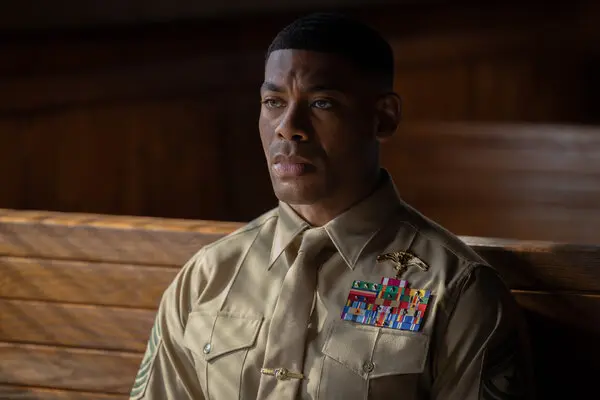
John grows into a Marine sergeant major and an extraordinarily patient sniper. On a months-long assignment in Russia targeting a man called Gray Wolf, Hal Jordan arrives uninvited, wraps the target in a construct, and flies off. The diplomatic fallout costs John a dishonorable discharge so the United States can save face. With his mother’s blessing he tries art school — the talent he was never allowed to prioritize as a child. That is where a recruiter finds him, hands him a ring, and asks him to construct his father’s watch in precise detail. Then the floor opens. “Jump.” The episode snaps back to the mall and the interview that started it.
The Guardian does not offer John a simple backup role. Hal, she says, has become unstable. They want a replacement who can operate in plain sight as a trainee until the moment they decide to activate him. John asks if those are his orders. She says they would be. He accepts. Comfort is irrelevant.
He races home to tell his parents. Hal has already been there, charming them as “the Midwest Huxtables” while the Stewarts’ faces stay tight. Outside, Hal drops the act. He does not want a sidekick. He does not want a backup. The only way John gets the ring is over his dead body. Then, almost cheerfully: training starts Monday. As OutKast’s “Gasoline Dreams” plays, John looks at a bird on the mailbox and says, “I think he likes me.”
That last beat is the episode in miniature: a man who was engineered for fearlessness still looking for a sign that someone, somewhere, is actually watching.
“OutKast” works because it refuses the usual orphan-and-destiny template. John’s parents are present, committed, and, in the show’s own unblinking view, abusive. They love him and they use him. Bernadette’s speeches about what a Black child will have to prove in a universe that already chose a white test pilot first give the hour its political spine without turning every scene into a lecture. The Guardians come off as indifferent gods who plant an idea and then go silent for decades. The birds were never real. The sacrifice was.
Aaron Pierre finally gets room to do more than stoic competence. The performance is all withheld feeling — the child who learned not to flinch, the Marine who waited months for one shot, the adult who claims he holds no grudge against the man who ended his military career. Laura Linney plays the Guardian with the slightly off cadence of someone translating cosmic bureaucracy into small talk. J. Alphonse Nicholson and Jasmine Cephas Jones make the parents both understandable and frightening.
The structure is ambitious and clean. Time jumps never feel like padding. The Russia mission, the art-school test, and the interview all feed the same question the Guardian is really asking: what kind of person did this childhood produce, and can that person replace Hal Jordan without the veteran ever knowing the plan?
The episode also quietly rewires the central relationship. Hal’s “over my dead body” line now carries the weight of a man who does not realize the Guardians already consider him a problem. John’s politeness looks less like deference and more like a man who has been taking orders since he was five. The Rushville mystery can wait. This hour was necessary.
Lanterns Episode 3 is the first time the series feels fully itself: part cosmic bureaucracy, part family tragedy, part superhero origin that understands how much damage “this is what it takes” can do. It is the best episode yet. New episodes air Sundays on HBO and stream on Max.