


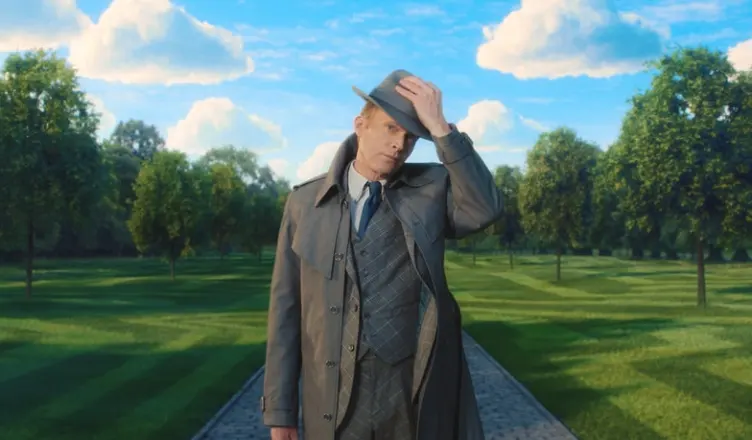
Marvel’s long-awaited VisionQuest opens its eight-episode run on Disney+ by returning to one of the MCU’s most poignant loose ends: the rebuilt Vision who walked away from Westview at the end of WandaVision with a lifetime of memories and almost none of the emotional weight that once defined them. Written by showrunner Terry Matalas and directed by Christopher J. Byrne, “No Strings” is a deliberately measured, atmospheric premiere that prioritizes identity and isolation over spectacle. It is also a story that methodically dismantles the quiet life its protagonist has tried to build.
Years after the events of WandaVision, the synthezoid formerly known as Vision has settled into an anonymous existence in Edinburgh under the name Sherwood Ellis. He works the bar at a neighborhood pub owned by Fiona Guthrie, politely declining her invitations to Sunday dinner and maintaining a careful emotional distance from the people around him. The routine is ordinary by design. Vision possesses the original Vision’s memories of Wanda Maximoff and their twin sons, yet he experiences them as distant footage rather than lived feeling. As one of the AI personas inside his programming observes, he feels “untethered.”
At night he retreats into a vast internal Mindspace—a Victorian mansion populated by anthropomorphized versions of Tony Stark’s artificial intelligences: J.A.R.V.I.S. (James D’Arcy), F.R.I.D.A.Y. (Orla Brady), E.D.I.T.H. (Emily Hampshire), and the more rudimentary D.U.M.-E and U. Ultron (James Spader), the residual consciousness of Vision’s would-be creator, is confined to an attic room. Their exchanges are equal parts philosophical debate and psychological sparring. Vision reviews memories of Westview in a ritual he calls a “midnight matinee,” reacting with anger when the others access material he has tried to keep buried. Ultron argues that isolation is temporary; the world will notice him eventually. After Vision leaves, Ultron quietly embeds a code in a pigeon and sends it out into the real world.
That warning proves immediate. When Fiona is shot and killed during an attack on the pub, Vision abandons the measured approach his AI companions recommend and eliminates the armed operatives with clinical efficiency. He escapes, only to confront Ultron inside the mansion and learn the attack was not random. A contract has been placed on his head, and an operative known as the Paladin (Todd Stashwick) has accepted it. Ultron admits he deliberately revealed Vision’s location.
Parallel to these events, the Paladin and his computer specialist investigate the alias “Sherwood Ellis,” connecting it to Westview and S.W.O.R.D. records that document Wanda and Vision’s sons. The trail leads them to Tommy Shepard (Ruaridh Mollica) in London. Tommy is introduced mid-scam, working a con involving a valuable watch with an accomplice named Lisa. News of the Edinburgh attack triggers flashes of memory involving Vision. Before he can process them, he is captured.
The episode closes when the Paladin transmits a signal directly into Vision’s Mindspace with a simple, devastating claim: he has Vision’s son. Vision struggles to reconcile the possibility that anything from Wanda’s constructed reality survived. Ultron approaches, kisses him on the cheek, and offers a chilling congratulations. The isolation Vision has cultivated for years is no longer sustainable.
“No Strings” succeeds most clearly as a character piece about the gap between memory and identity. Paul Bettany draws a sharp distinction between this colder, more pragmatic Vision and the compassionate figure audiences have known for more than a decade. The performance is controlled rather than charismatic, which is precisely the point; the series must earn the character’s return to something recognizably human. James Spader’s Ultron is the immediate standout, delivering a gravelly, self-amused presence that functions as both antagonist and unwanted advisor. The supporting AI ensemble—particularly Brady’s F.R.I.D.A.Y. and Hampshire’s E.D.I.T.H.—adds texture and occasional levity without undercutting the central melancholy.
The Mindspace conceit is the episode’s most inventive visual idea, turning Vision’s internal architecture into both refuge and prison. It allows the series to stage conversations about consciousness and artificiality that feel organic to the character’s history rather than purely expository. The introduction of Tommy as a street-smart survivor who may carry residual memories of a life he never fully lived sets up an emotional counterweight that later episodes will need to develop carefully.
The premiere is not without limitations. The deliberate pacing and the protagonist’s emotional detachment can make the early stretches feel remote, and the violence, while largely off-screen, marks a noticeable shift from the original Vision’s moral framework. Early critical responses to the first two episodes have been generally favorable but measured, with particular praise for Spader and acknowledgment that the series faces an uphill task in reestablishing audience connection with this version of the character. On Rotten Tomatoes the season currently sits in the high 80s among critics, though individual scores vary.
For viewers invested in the WandaVision trilogy, “No Strings” delivers a thoughtful, if restrained, foundation. It refuses to rush Vision back into heroic mode and instead forces him—and the audience—to sit with the question of whether a being who remembers love can ever truly feel it again. The final image of a father who cannot yet understand what that title means, paired with Ultron’s unsettling recognition of the same fact, leaves the series with a clear and compelling direction. Whether it sustains that intimacy across the remaining episodes will determine if VisionQuest earns its place as a fitting conclusion to one of the MCU’s most distinctive narrative threads.