


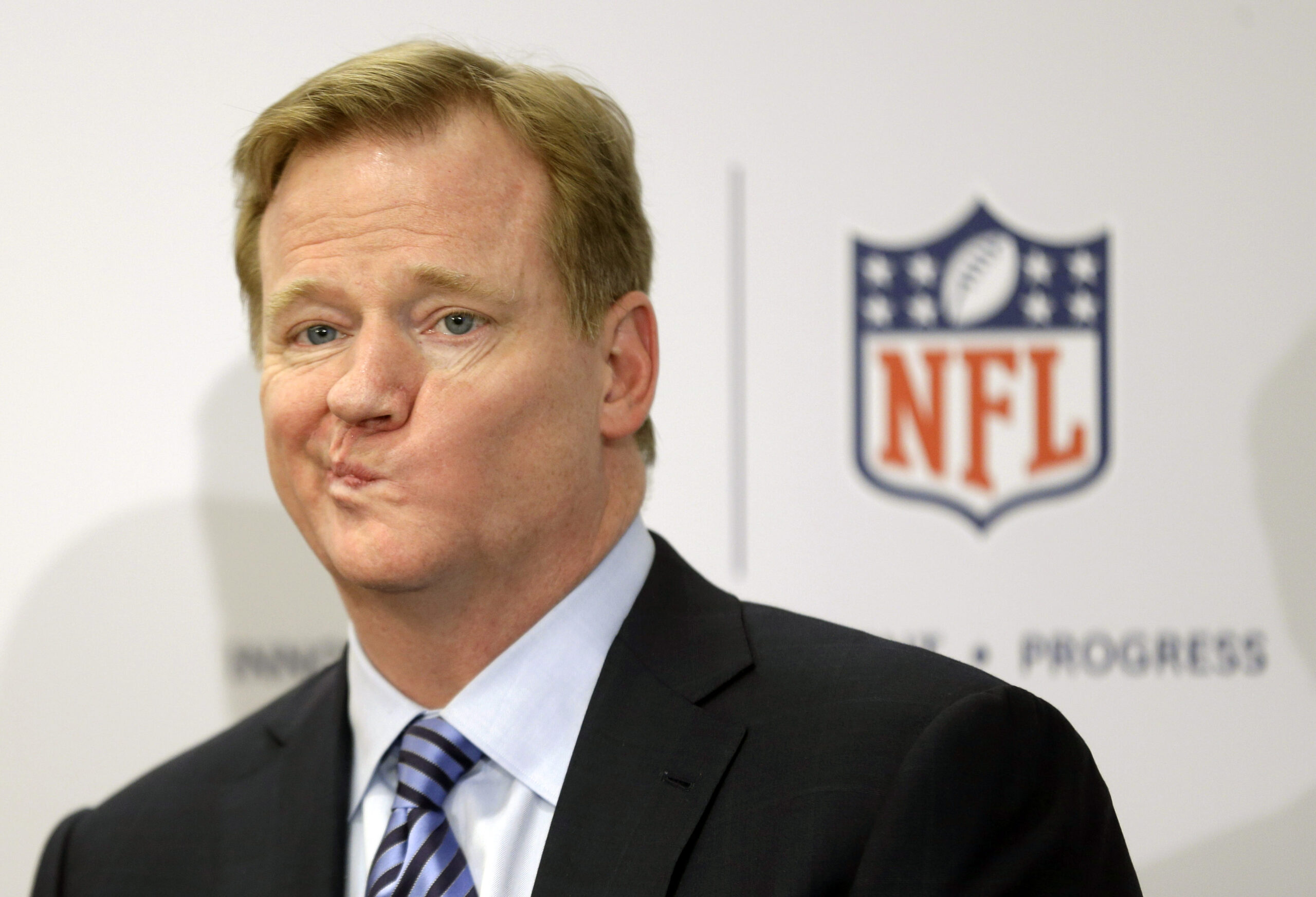
In a candid admission amid mounting fan frustrations over controversial calls, NFL Commissioner Roger Goodell has revealed that the league is actively exploring artificial intelligence (AI) to bolster officiating accuracy and fairness. Speaking to reporters on Wednesday, Goodell emphasized the need to harness cutting-edge technology as the game evolves at breakneck speed, potentially ushering in a new era where human referees are augmented by machine precision.
The remarks, delivered during a press interaction following recent high-profile officiating blunders—like those that fueled debates in the Kansas City Chiefs’ victory over the Detroit Lions—underscore the NFL’s proactive stance on modernization. “The NFL is looking into how AI might be able to help out officiating in the future,” Goodell stated plainly.
Goodell’s comments build on a theme he’s revisited in recent appearances, including a podcast episode on Fitz and Whit hosted by former NFL players Ryan Fitzpatrick and Andrew Whitworth. There, he delved deeper into the rationale, painting a picture of a league at a crossroads. “The game is getting faster. It’s harder to officiate,” Goodell explained. “I think our guys do a great job, but there’s no such thing as perfection on the field. What we want to do is get it right and avoid the big mistakes because it should be decided amongst the men playing the game.”
He stressed that while the NFL has invested heavily in training officials—”We have really worked hard to improve, educate, and try to give the skills to officials. And I think they have gotten better”—technology remains the ultimate supplement. “We have to give them the tools to try to be better and keep up with the game,” Goodell added. Enter AI: not as a replacement for the striped-shirted arbiters, but as an enhancer providing “better input so that we can get it right on the field.”
Potential applications abound, drawing from early experiments and parallels in other sports. AI could automate routine judgments, such as determining where a punt crosses the sideline, spotting the football for first downs, or flagging illegal formations and downfield penalties on passes. It might even clarify chaotic moments, like distinguishing a lateral from a fumble or detecting out-of-bounds steps in real time. The NFL has already dipped its toes into tech-assisted calls with replay assist and Next Gen Stats for player tracking, but Goodell envisions AI as the next leap—much like HD cameras that supplanted the traditional chain gang for line-to-gain measurements.
Goodell drew inspiration from global precedents. Tennis’s Hawk-Eye system resolves line calls with near-perfect accuracy; soccer employs goal-line technology to settle razor-thin margins; Major League Baseball is piloting automated strike zones; and the NBA experiments with AI for goaltending reviews. “I always run by [the fact that] you have to embrace technology. Technology is changing our lives. It changes the way we play the game, [and] it changes the way we watch the game. We have to embrace it,” he said, framing AI as essential for maintaining the NFL’s competitive edge.
Yet, Goodell was quick to acknowledge the hurdles. The NFL, a sport steeped in ritual—from the dramatic pauses of chain measurements to the human element of on-field decisions—must navigate a tightrope between progress and preservation. “How do you balance that tradition vs. innovation? And how do you keep moving forward because you have to ultimately. But you also have to respect that tradition and finding out where that line is. It’s hard, it really is,” he reflected. Removing the chain crew, for instance, might streamline operations but erode the game’s theatrical flair, a tension the league is loath to exacerbate.
Critics worry about over-reliance on algorithms, potential biases in AI training data, and the loss of the “human touch” that defines football’s unpredictability. Implementation timelines remain vague—no firm rollout date was mentioned—but Goodell hinted at ongoing pilots, signaling that AI’s integration could begin as early as the next season.
As the 2025 season barrels toward the playoffs, Goodell’s AI overture arrives at a pivotal moment. With officiating under the microscope—bias allegations, replay delays, and game-altering errors eroding trust—the promise of AI-assisted calls could restore faith in the league’s integrity. “Will AI be a part of officiating in the future? I think it will be,” Goodell affirmed, a bold prediction that could redefine football’s black-and-white world in shades of algorithmic gray.
Whether this leads to cleaner games or unintended controversies remains to be seen. For now, it’s a reminder that even in America’s most tradition-bound sport, the future is being coded one line at a time.