


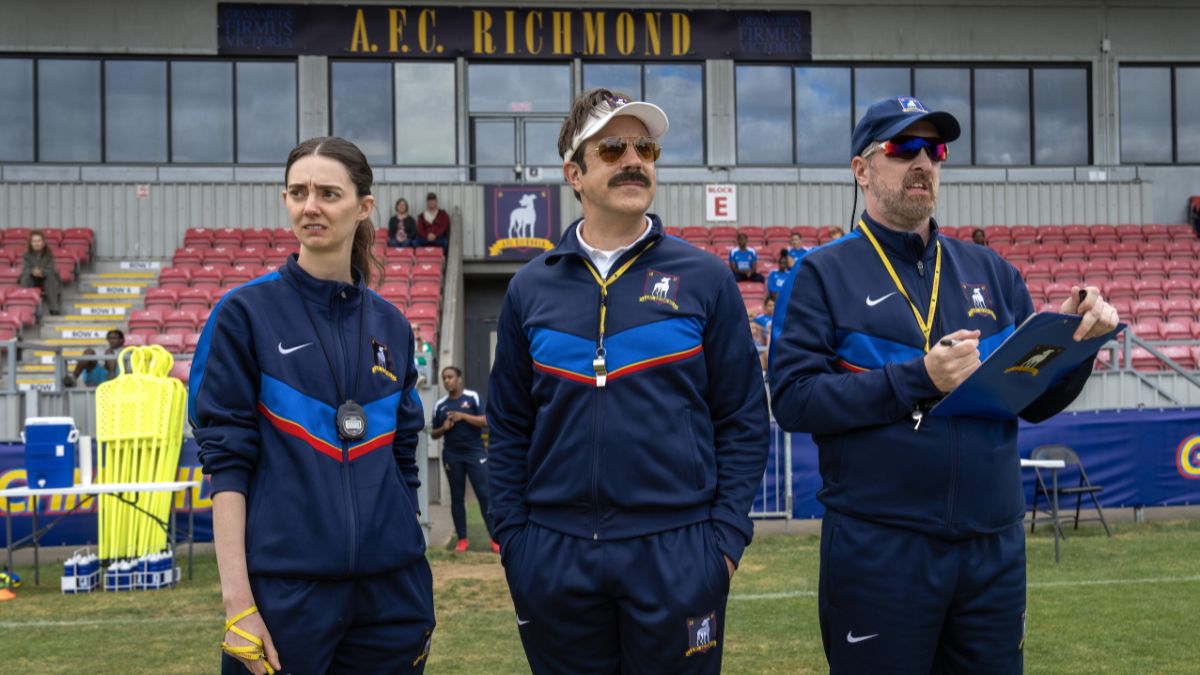
Ted Lasso Season 4, Episode 3, “Richmond’s Got Talent,” continues the series’ return to AFC Richmond by placing the newly formed women’s side, the Lady Greyhounds, at the center of the story. After two episodes of setup, the hour shifts from introductions to practical problems: a depleted roster, skeptical stakeholders, logistical headaches, and the first real test on the pitch.
The episode opens with an immediate crisis. The team’s remaining striker learns she is pregnant, leaving the coaches without a recognized goal scorer ahead of their first friendly. Assistant coach Alice Chilton (Tanya Reynolds) floats two options: recruiting a former teammate, Gemma Jay (Abbie Hern), now in law school, or holding open tryouts. She treats the latter as a joke. Ted Lasso and Coach Beard treat it as a plan, citing stories of unexpected talent. Alice counters with Susan Boyle. The tryouts proceed.
Meanwhile, a shareholders meeting exposes lingering resistance to the women’s team. Keeley Jones faces heckling and the public airing of a previously unseen pessimistic report commissioned by Higgins. The club’s shirt sponsor, Pinter & Sons, grows skittish. Rebecca Welton travels to Canary Wharf to meet the company’s CEO and, through a mix of moral argument and persistence, keeps the sponsorship intact. The subplot underscores the real-world barriers women’s teams often face in funding, visibility, and institutional buy-in. Rebecca’s repeated cancellations of plans with Matthijs illustrate how those demands compete with her personal life.
The tryouts themselves introduce several new faces. Lizzie (Faye Marsay), a single mother who brings her young son because she cannot find childcare, stands out for her defensive skill and ability to defuse tension among other players. Shannon, a recurring local soccer enthusiast from earlier seasons, earns a spot thanks to Ted’s belief in her potential despite reservations from Alice and Beard. Dani Rojas’s sister Maria appears with similar enthusiasm but lacks the same footballing ability and does not make the cut. The coaches still lack a striker. Alice and Ted approach Gemma; old tensions surface when Gemma recalls Alice’s harsh criticism from their playing days. After some hesitation, Gemma agrees to join while continuing her studies.
Keeley’s parallel crisis involves the team’s kits failing to arrive. Roy Kent’s niece Phoebe and her friends step in to create homemade versions, a small, characteristically heartfelt solution. Roy later hands Keeley a one-page “report” that simply reads “Fuck ’em.” The gesture lands.
The friendly against Hayes & Yeading United is workmanlike rather than spectacular. Richmond stays organized at the back but creates little going forward. Gemma enters late as a substitute and scores the winner. The modest crowd and limited broadcast (streamed rather than traditionally televised) keep the moment grounded; the victory feels earned rather than miraculous. Rebecca and Matthijs finally share a date, and the episode closes on Susan Boyle’s voice, circling back to the theme of overlooked talent.
The episode is effective at what Ted Lasso does best: blending optimism with recognizable obstacles. It introduces Lizzie, Gemma, and Shannon with enough personal detail to make them more than roster fillers. Lizzie’s dual role as parent and player, Gemma’s decision to pursue both football and law, and Shannon’s raw enthusiasm give the women’s team distinct personalities. The hour also addresses practical inequities—childcare, kit delays, sponsor hesitation, and smaller crowds—without turning them into lectures. Tanya Reynolds continues to give Alice a sharp, no-nonsense edge that contrasts usefully with Ted’s style. Faye Marsay and Abbie Hern make strong first impressions.
The formula is familiar. Problems arise, the group rallies, and a late-game moment delivers the desired result. Some B-plots, particularly Rebecca’s scheduling conflicts and Roy’s well-meaning but clumsy support of Keeley, feel like standard sitcom interruptions rather than essential developments. The stakes for the Lady Greyhounds remain relatively low at this stage of the season; the first win arrives exactly when the story needs it. These are not fatal flaws in an episode designed to get the team on the field and give viewers reasons to care about the new players.
“Richmond’s Got Talent” succeeds as a mid-season building block. It moves the women’s team from concept to actual competition, plants seeds of conflict (especially between Alice and Gemma), and reaffirms the series’ core belief that belief itself can uncover unexpected ability. It is not the most surprising hour of the season, but it is one of the more focused and likable. The Lady Greyhounds now have a result, a few new teammates, and a clearer sense of the work still ahead.