


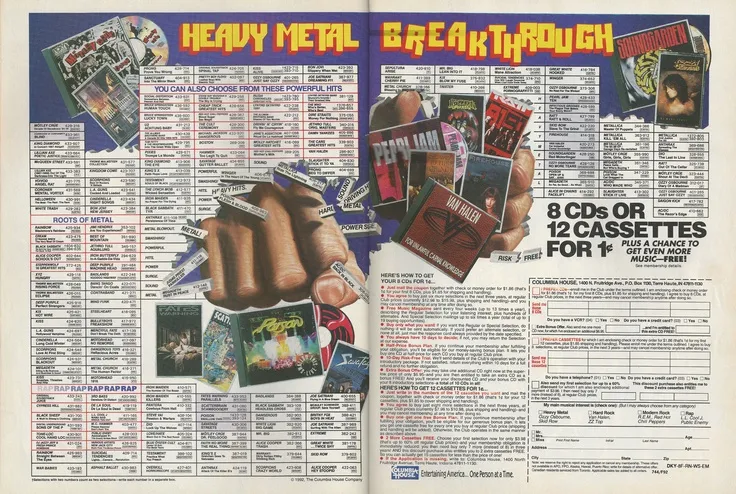
The mail-order music giant that once promised 12 CDs for a penny — and at its peak claimed 16 million members — will stop accepting new orders after September 15, 2026. A notice on the company’s website marks the end of a 71-year run that began with vinyl and outlasted tapes, CDs, and even DVDs, only to be undone by streaming.
Columbia House started in 1955 as the Columbia Record Club, an experiment by Columbia Records (then part of CBS) to reach listeners in rural and suburban areas who lacked easy access to record stores. The pitch was simple and irresistible: join, get a stack of albums for pennies, and commit to buying a set number of additional titles at regular club prices. By 1963 the club already accounted for roughly 10 percent of the U.S. music retail market. It later licensed titles from other labels, expanded into 8-tracks, cassettes, and CDs, and rebranded as Columbia House in the early 1970s.
The model worked because it was convenient and cheap — at least at the start. Members received monthly selections unless they mailed back a reply card to decline them, a practice known as negative-option billing that later drew widespread criticism and legal scrutiny. Still, the club helped millions of people, especially those far from brick-and-mortar shops, build real collections. At its height in 1996, Columbia House reported about 16 million members and annual revenue as high as $1.4 billion. Together with rival BMG Music Service, the two clubs represented a substantial slice of all CD sales in the United States.
The company adapted as formats changed. It added videotapes, then DVDs and Blu-rays. Music sales, however, began a long decline in the late 1990s and early 2000s as big-box retailers, internet shopping, file-sharing, and digital downloads took hold. Columbia House ended its music-club operations around 2009–2010 and shifted entirely to home video. Canadian operations closed the same year. After a 2015 bankruptcy, the remaining business continued as a much smaller DVD and Blu-ray mail-order service under new ownership that licensed the Columbia House name from Sony Music Entertainment.
That last remnant is now winding down. Existing orders and credits will be honored, and the site still lists a modest selection of titles (including some books), but no new customers will be accepted after mid-September.
Columbia House did not invent mail-order music, but it made it a national habit. For a generation of listeners, the arrival of a padded envelope in the mailbox was a small event — a new album without a trip to the store. The club survived every physical-format shift because it sold convenience and volume. Streaming offered both in even greater measure, without the commitment, the reply cards, or the warehouse in Terre Haute.
The brand that once shipped more than a billion records will now fulfill its final obligations and close. What remains is the memory of those penny deals and the collections they helped create — a reminder of how music used to travel from label to living room, one package at a time.
Still Owe Columbia House by Litehouse Tees
Oops