


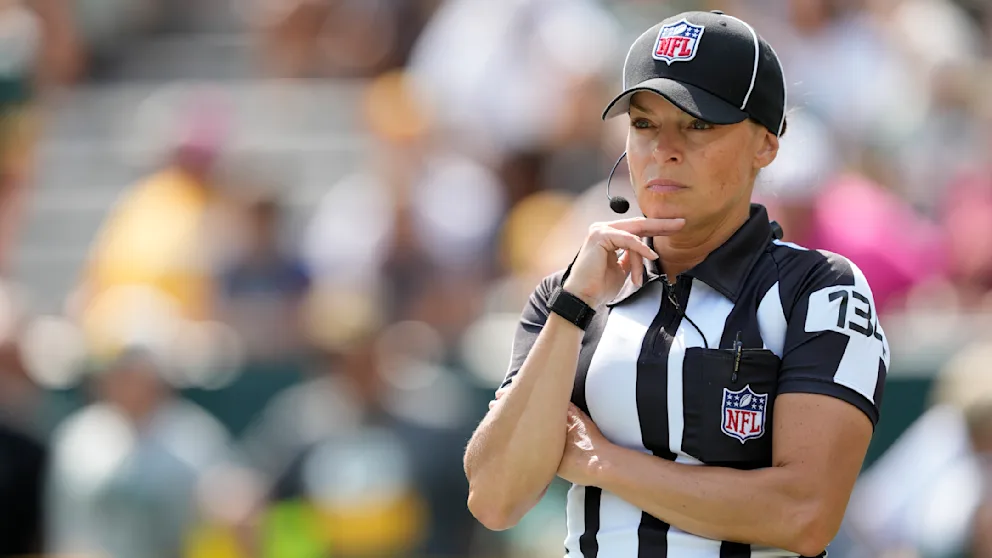
Robin DeLorenzo, who made history in 2022 as one of the first three women hired as permanent on-field NFL officials, has filed a federal lawsuit against the National Football League and two former top officiating executives. The complaint, filed Friday in the U.S. District Court for the Southern District of New York, accuses the league of gender-based scrutiny, disparate treatment, humiliation, and retaliation that she says culminated in her termination on February 18, 2025.
DeLorenzo, a New Jersey native with more than 20 years of officiating experience at the high school, college (including the Big Ten), and USFL levels, worked primarily as a down judge/line judge. She was hired by the NFL in 2022 alongside a small cohort of female officials in what the league had touted as a step toward greater diversity in a traditionally male-dominated field. Her lawsuit names the NFL, former Senior Vice President of Officiating Walt Anderson, and former officiating trainer Byron Boston as defendants. It raises 12 causes of action under Title VII of the federal Civil Rights Act and analogous New York and New Jersey anti-discrimination laws.
According to the 32-page complaint, DeLorenzo was subjected to an environment that “fixated on her gender from day one,” treating female officials as “novelties to be controlled, disciplined, or pushed out — never as professionals entitled to equal opportunity.” Specific allegations include:
- Gender-based scrutiny and unequal treatment: Supervisors repeatedly instructed her to wear her hair in a visible ponytail through her cap’s hole so it would be clear a woman was on the field. She received ill-fitting men’s uniforms and had to purchase and alter her own gear, including shorts and patches, while never being provided proper women’s undergarments or weather-appropriate clothing.
- Humiliation during evaluations and training: In her rookie season at Pittsburgh Steelers training camp, she was required to perform a singing routine in front of players and her crew — a “rookie hazing” ritual typically reserved for players — while Anderson allegedly recorded her despite her objections. She was also forced to attend a low-level college officiating clinic using NCAA rules and mechanics, an assignment her union successfully grieved as unprecedented for an active NFL official.
- Lack of support and development given to male officials: The suit claims she was denied the same training, mentoring, and fair grading opportunities provided to her male counterparts. Evaluations were allegedly conducted through a system controlled by the very supervisors she accuses of bias, leading to harsher scrutiny on similar calls. She also reported verbal abuse from a crew chief, including repeated profanity-laced directives to “shut your fucking mouth” and being ignored or shut down during on-field discussions.
DeLorenzo seeks reinstatement to her position as an NFL referee, along with compensatory and punitive damages, back pay, and other relief.
The NFL strongly denies the allegations. In a statement to multiple outlets, spokesperson Brian McCarthy said: “The NFL is committed to providing a fair and supportive environment for all of its game officials. Ms. DeLorenzo was terminated following three seasons of documented underperformance. The allegations in this lawsuit are baseless, and we will vigorously defend against them in court.”
DeLorenzo’s attorney has described the case as highlighting a stark contrast between the NFL’s public commitments to diversity, equity, and inclusion and the experiences of one of its few female officials. Only a handful of women have ever officiated NFL games on a full-time basis, with Sarah Thomas (hired in 2015) becoming the first and Maia Chaka joining in 2021.
The lawsuit arrives as the league continues to face scrutiny over workplace culture and gender equity across its operations. DeLorenzo’s case is the latest high-profile challenge to the NFL’s handling of diversity in officiating, a role that demands precision under intense public and internal pressure.
The case has been assigned to U.S. District Judge Analisa Torres. The NFL has not yet filed a formal response in court.