


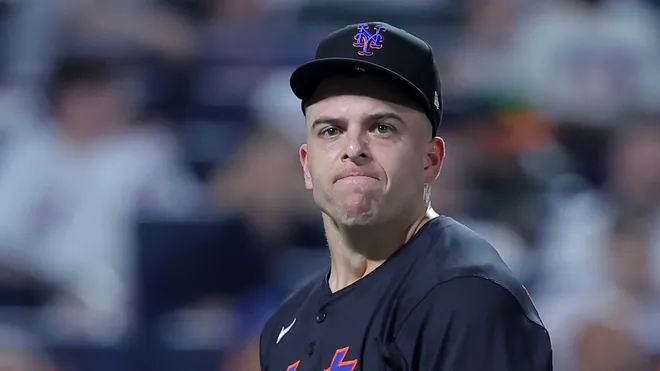
The New York Mets made a significant splash at the 2025 trade deadline, acquiring two-time All-Star reliever Ryan Helsley from the St. Louis Cardinals on July 30 in a bid to bolster their bullpen for a postseason push. The trade, which sent three minor leaguers—third baseman Jesus Baez and pitchers Nate Dohm and Frank Elissalt—to St. Louis, was heralded as a “slam dunk” for a win-now Mets team. With a reputation as one of baseball’s premier closers, Helsley was expected to form a formidable tandem with incumbent closer Edwin Díaz. However, since joining the Mets, Helsley’s performance has been a tale of electrifying potential marred by inconsistency, raising questions about his adjustment to a new role and environment.
Adam Klepfer on X (formerly Twitter): “Mets trading for Ryan Helsley might be the best trade deadline move for the Phillies. Mets are an absolute train wreck / X”
Mets trading for Ryan Helsley might be the best trade deadline move for the Phillies. Mets are an absolute train wreck
Before arriving in New York, Helsley was a cornerstone of the Cardinals’ bullpen. From 2022 to 2024, he posted a stellar 1.83 ERA, a 0.954 WHIP, 12.1 strikeouts per nine innings, and 82 saves, amassing a 7.2 WAR. In 2025, prior to the trade, he continued to perform well, recording a 3.00 ERA, 10.3 strikeouts per nine innings, and 21 saves in 36 appearances. His fastball, averaging over 99 mph and often touching triple digits, paired with a devastating slider, made him one of the most feared relievers in the game. Mets fans were thrilled at the prospect of his “lights out” presence, especially with his dramatic entrance to AC/DC’s “Hells Bells” at Citi Field.
Helsley’s Mets debut on August 1 against the San Francisco Giants offered a glimpse of his potential. Pitching in a tied game in the ninth inning, he struck out three batters, allowed two hits, and maintained a scoreless frame despite a 64% whiff rate and a fastball topping out at 101.4 mph. The performance, though in a 4-3 extra-inning loss, earned praise from manager Carlos Mendoza, who noted, “He was pretty good. 100 first pitch… He’s a pretty tough at-bat.” Teammate David Peterson called it “lights out,” and social media buzzed with excitement about the bullpen’s new weapon.
Despite the strong start, Helsley’s transition to the Mets has been rocky. Unlike his defined closer role in St. Louis, he has primarily served as a setup man for Díaz, a shift that has required adjustment. In six appearances and five innings with the Mets, Helsley has posted a 5.40 ERA and a 2.00 WHIP, with six strikeouts, two blown saves, and two losses (0-1 record). Opposing hitters are batting .408 against his fastball, a significant jump from the .406 mark with the Cardinals earlier in 2025 and a far cry from the .276 average against it in 2024. His slider, typically a put-away pitch buried below the knees, has often caught too much of the plate, leading to costly hits.
A notable low point came on August 10 against the Milwaukee Brewers. Helsley entered a tied game in the seventh inning and threw a 103.8 mph fastball—the fastest pitch in Mets history in the Statcast era. However, the outing unraveled. After inducing a pair of foul balls, Isaac Collins fouled off the record-breaking pitch and then singled for an RBI. A pitch clock violation nullified a flyout, and William Contreras capitalized with a two-run homer off a 100.1 mph fastball, resulting in a 7-4 Mets loss. This game epitomized Helsley’s struggles: elite velocity undermined by command issues and bad breaks.
Another critical moment occurred on August 14 against the Atlanta Braves. Protecting a 3-2 lead in the eighth, Helsley issued a one-out walk to Marcell Ozuna, followed by back-to-back RBI doubles from Michael Harris II and Ozzie Albies, surrendering the lead in a 4-3 defeat. Mendoza pinpointed the issue: “He’s leaving that slider up in the strike zone… Good hitters are going to make you pay for it.” Helsley acknowledged the challenge, stating, “I’m trying to figure out that role, that routine and be ready when my name is called. I haven’t been good.”
Helsley’s struggles are not solely due to poor performance. The transition from closer to setup man requires a different mindset and preparation, as the timing of appearances is less predictable. In St. Louis, Helsley knew he’d typically pitch the ninth with a lead; in New York, he’s often called upon in the seventh or eighth, sometimes in tie games or high-leverage situations. He admitted postgame, “For everybody else to do the job and not to do yours, it sucks. You never want to be that guy and be the reason the team loses.”
The Mets’ broader bullpen woes have amplified Helsley’s struggles. Despite adding Helsley, Tyler Rogers, and Gregory Soto at the deadline, the team’s relief corps has faltered, with a 4.87 ERA since June 1, ranking 25th in the majors. The Mets have lost 13 of their last 15 games since July 28, slipping to a half-game lead over the Cincinnati Reds for the final NL Wild Card spot as of August 14. Helsley’s -0.4 WAR since joining the Mets reflects his role in these losses, though defensive miscues, like Ronny Mauricio’s failure to corral a grounder against Milwaukee, have contributed to unearned runs.
Despite the rocky start, there are reasons to believe Helsley can regain his form. His fastball velocity remains elite, consistently hitting 99-103 mph, and his 13.5 strikeouts per nine innings with the Mets show his swing-and-miss stuff is intact. Mendoza remains confident, emphasizing the need to “finish those pitches, especially the breaking ball.” Helsley’s track record suggests he can adjust; his 82 saves from 2022-2024 and 1.83 ERA over that span are evidence of his ability to dominate. The Mets are unlikely to abandon their trade-deadline acquisition, though there’s talk of shifting eighth-inning duties to other relievers like Rogers, who has performed well, until Helsley finds his rhythm.
As the Mets fight to secure a playoff spot, Helsley’s ability to adapt will be crucial. The team’s postseason hopes hinge on a bullpen that can protect leads, especially with starters like Kodai Senga showing signs of returning to form. Helsley’s electric arm remains an asset, but command and consistency are critical. “We have to get him back on track,” Mendoza said, echoing the sentiment that talent alone isn’t enough—execution is key.
For now, Mets fans are left with a mix of awe at Helsley’s raw stuff—like the 103.8 mph fastball that made history—and frustration at the results. With the season hanging in the balance, Helsley’s ability to harness his potential in New York will determine whether he becomes the bullpen savior the Mets envisioned or a cautionary tale of a trade that didn’t pan out.
Adam Klepfer on X (formerly Twitter): “Mets trading for Ryan Helsley might be the best trade deadline move for the Phillies. Mets are an absolute train wreck / X”
Mets trading for Ryan Helsley might be the best trade deadline move for the Phillies. Mets are an absolute train wreck