


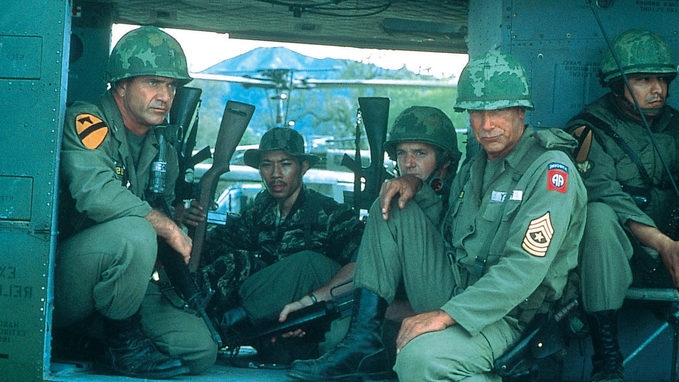
Randall Wallace’s 2002 war drama We Were Soldiers stands as one of the more earnest and respectful Hollywood takes on the Vietnam War. Adapted from the bestselling book We Were Soldiers Once… and Young by Lt. Gen. Hal Moore and journalist Joseph L. Galloway, the film dramatizes the Battle of Ia Drang in November 1965—the first major engagement between U.S. and North Vietnamese forces. What elevates it beyond a standard combat picture is its star-studded cast of familiar faces, many of whom deliver grounded, memorable performances that keep the human stakes front and center amid the chaos.
Mel Gibson anchors the film as Lt. Col. Hal Moore, the devout Catholic, Harvard-educated commander of the 1st Battalion, 7th Cavalry. Gibson plays him with restrained intensity rather than his more flamboyant action-hero energy, conveying the weight of leadership as he trains young soldiers and then leads roughly 400 men into the Ia Drang Valley against a much larger North Vietnamese force. Beside him, Sam Elliott is perfectly cast as the gruff, no-nonsense Sgt. Maj. Basil Plumley—a three-war veteran whose quiet toughness and dry wit provide some of the film’s most memorable moments. Greg Kinnear brings cocky competence and growing resolve as helicopter pilot Maj. Bruce “Snake” Crandall, while Barry Pepper is effective as the civilian journalist Joe Galloway who finds himself fighting alongside the troops.
The supporting ensemble is packed with recognizable faces who make the unit feel lived-in. Chris Klein (as 2nd Lt. Jack Geoghegan) and Keri Russell (as his wife Barbara) handle the personal stakes of a young couple facing the war’s cost. Madeleine Stowe is strong as Julie Moore, the officer’s wife who organizes support for the families back at Fort Benning as casualty notifications arrive. Other familiar names appear throughout, including Ryan Hurst, Marc Blucas, Clark Gregg, Dylan Walsh, and even an early-career Jon Hamm as Capt. Matt Dillon. The North Vietnamese side is humanized through Đơn Dương’s portrayal of Lt. Col. Nguyễn Hữu An, avoiding one-dimensional villainy and underscoring the shared courage and suffering on both sides.
Wallace, who also wrote the screenplay (and previously wrote Braveheart), keeps the focus on leadership, duty, and the personal cost of war rather than broad political critique. The battle sequences are intense and chaotic without becoming pure spectacle, emphasizing the “air cavalry” tactics and the desperate fight in the “Valley of Death.” Intercutting with the home-front scenes of the wives adds emotional weight, even if some of those moments lean on familiar war-movie tropes. Critics noted that the film occasionally leans into clichés, but most agreed it succeeds in putting human faces on the soldiers of both sides. Roger Ebert praised its clear storytelling and character focus, giving it 3.5 out of 4 stars. Audiences responded strongly as well, awarding it an “A” CinemaScore.
At a time when many Vietnam films dwelled on moral ambiguity or national trauma, We Were Soldiers chose to honor the bravery and professionalism of the troops who fought in those early days. The result is a solid, affecting war drama elevated by an ensemble of familiar faces who bring credibility and heart to the material. It’s not the most radical Vietnam film ever made, but it remains a powerful tribute to the men and women who lived through Ia Drang—and a reminder that strong casting can make history feel immediate and personal.