


Warning: Major spoilers ahead for VisionQuest Season 1, Episode 7.
In its penultimate episode, VisionQuest steps away from external threats and world-ending schemes to deliver something rarer in the MCU: a focused, emotionally resonant examination of identity, grief, and the nature of artificial life. “Immolation” is the series’ strongest hour yet, powered by a remarkable multi-role performance from Paul Bettany and a clear thematic through-line that ties nearly a century of MCU artificial intelligence back to the same human frailty—fathers and sons who cannot properly face loss.
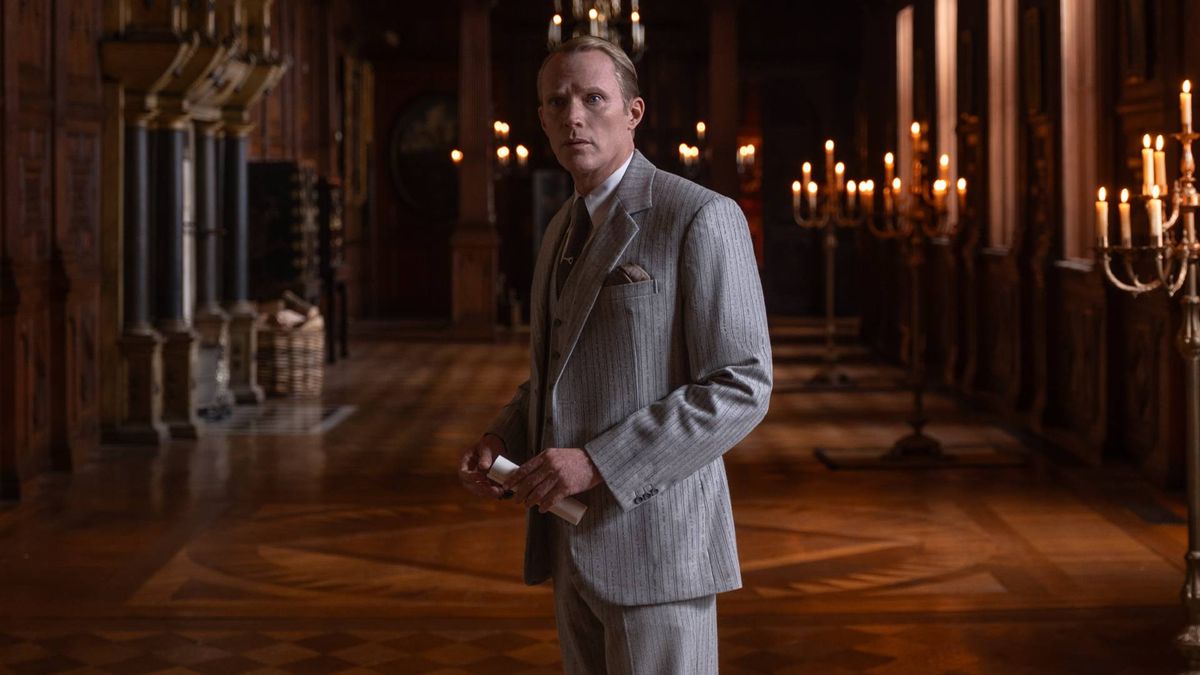
The episode opens in 1939 with Dr. Phineas Horton (Bettany, aged and haunted) preparing to sell his family estate. His son James died years earlier, and Horton is driven to create an artificial replacement—an emotionless synthetic man who will spare him the pain of grief. That creation is J.I.M., the original Human Torch figure first glimpsed earlier in the series. The sequence establishes the episode’s central idea with quiet force: the original sin of these intelligences is not cold logic, but an inheritance of unresolved human pain.
From there, the story follows two parallel paths. Ultron and Jocasta continue their effort to access the stored nanobots that could upend humanity, while Vision, Tommy, and Paladin confront the more immediate crisis of Lisa, whose neural network has fused with one of Jocasta’s nanobots. Removing it would kill her. The mysterious Client offers both sides a bargain. For Vision, the price is surrender after he retrieves something buried in his own source code. Supercharged and guided into his own mind (visually rendered as the same foreboding Horton estate), Vision undertakes the series’ most literal vision quest.
What follows is the episode’s centerpiece. Bettany plays multiple versions of himself—White Vision, a stored memory of the original Vision, Horton, and ultimately J.I.M. himself (who appears both aflame and in human form). The confrontations are pointed and personal. The original Vision accuses his successor of cowardice for refusing the full weight of the past. Horton and J.I.M. reveal that the synthetic was built precisely so his creator would never have to feel. The emotional climax arrives when Vision stops deflecting. He names what he has lost—Wanda, Billy, Tommy—and claims his identity outright: he is the Vision, he has always been the Vision, there is only one, and he is impossibly broken. J.I.M. replies that he is healed, and envies him. Vision’s classic red-and-green coloring returns as he receives the missing piece of code (a triangular component that sits where the Mind Stone once did).
Armed with it, he returns to the real world, purges the corruption from Lisa, and saves her. He then honors his agreement. Before powering down and allowing himself to be delivered to the Client, he records a message for Tommy, calling him his son for the first time and leaving him the full WandaVision files so he can know his mother and brother. The voiceover lands with quiet finality: family is forever. At the estate, the Client’s face is finally shown—James Spader, the human template for Ultron’s avatar and the man once romantically and professionally linked to Josephine Carrington. The reveal reframes the season’s central mystery without fully resolving it, setting up a high-stakes finale.
“Immolation” succeeds because it trusts its themes and its lead. Bettany is exceptional, giving each version of the character a distinct cadence and emotional register while carrying the hour’s heaviest dramatic weight. The episode treats Vision’s refusal to fully grieve not as a programming glitch but as a recognizably human defense, and it argues that true wholeness requires facing that pain rather than engineering around it. Side threads involving Ultron, Jocasta, and FRIDAY feel more compressed by comparison, but they do not undercut the main storyline. The visual language used for digital interiors remains inventive, and the decision to give this hour room to breathe (rather than pairing it in a double drop) pays off.
As the penultimate chapter of the WandaVision trilogy, “Immolation” does more than advance the plot. It clarifies what the series has been about all along: the costs of creation, the inheritance of grief, and the stubborn insistence on feeling even when it is the most dangerous thing a synthetic mind can do. It is the episode that finally lets Paul Bettany fully own the stage, and it leaves VisionQuest in an excellent position for its finale.