


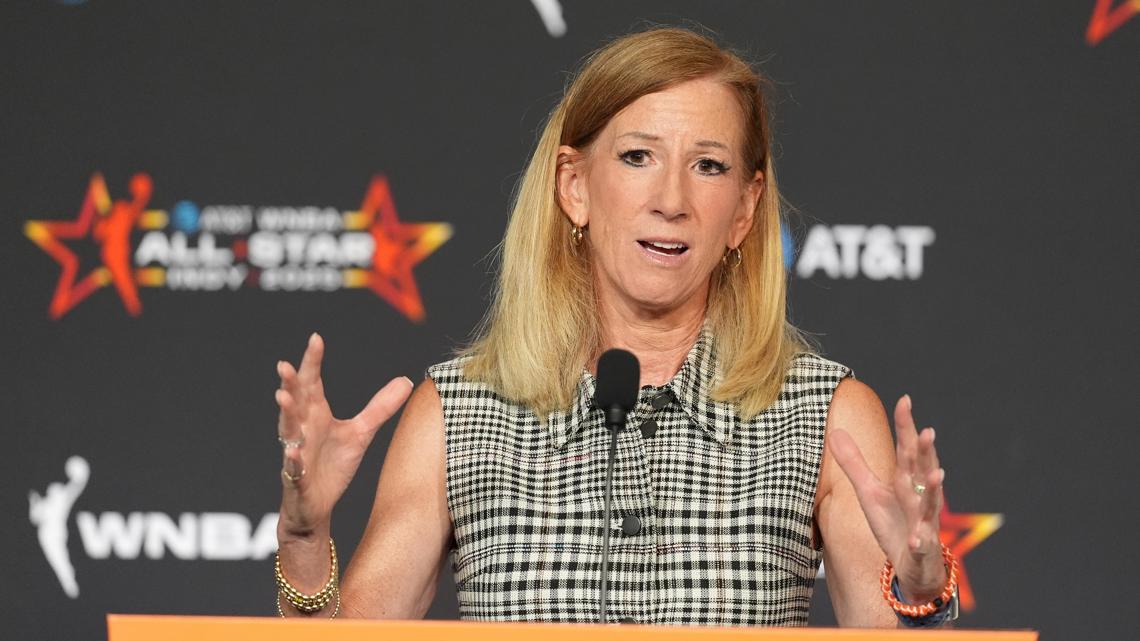
Cathy Engelbert, the first commissioner in WNBA history, will retire at the end of 2026, the league announced Friday, closing a seven-and-a-half-year tenure that transformed the business of women’s basketball even as it left her relationship with players and the league’s public standing battered by controversy.
NBA Commissioner Adam Silver made the announcement, calling Engelbert’s watch “the most significant period of growth in the league’s 30-year history.” Engelbert, who turns 62 in November, said she had always planned a shorter stay. “When I first came to the league I intended to do this for 3½ years,” she told the Associated Press. “The 7½ years exceeded that time. This is a really good time given the financial transformation journey we’ve been on.” She insisted the decision was hers alone.
The numbers support the growth claim. Franchise values that averaged about $10 million in 2019 now sit near $460 million. Viewership is up roughly 454 percent and attendance about 70 percent since she arrived. Media rights are valued at $3.1 billion. The 2026 collective bargaining agreement produced the first million-dollar player salaries and a $7 million salary cap. Expansion that began with the Golden State Valkyries now includes Portland and Toronto, with Cleveland, Detroit and Philadelphia still to come on a path to 18 teams by 2030. The regular season will stretch to a record 50 games in 2027. A charter-flight program and a forthcoming centralized replay center were also products of her office.
That is the ledger Engelbert leaves. The atmosphere around the league is another matter.
Players spent much of the last two seasons airing grievances in public. Minnesota’s Napheesa Collier labeled the WNBA’s leadership “the worst in the world” after last season and described a private conversation in which she said Engelbert told her “only losers complain about the refs” and suggested Caitlin Clark should be grateful for off-court earnings. All-Star crowds chanted “pay them.” Officiating, player safety and the handling of physical plays involving Clark drew congressional letters and repeated criticism that the league office was reactive rather than present. Several players said they never heard from the commissioner after high-profile incidents of on-court contact or online racial abuse.
The latest storm arrived this summer over eligibility. Former NBA players Enes Kanter Freedom and Royce White declared for the 2027 WNBA draft after identifying as women, forcing the league to address a clause in the new CBA that states “only players who are women are eligible” without defining the term. Indiana’s Sophie Cunningham publicly argued biological males should be barred. Engelbert sent teams a memo calling the subject “complex and nuanced,” saying there were “no immediate eligibility matters” and denouncing “bad-faith efforts to use these topics to demean or marginalize others.” The league later indicated the two men would not be eligible, while declining to give the declarations more oxygen. Conservative groups protested outside arenas. Engelbert accused outsiders of trying to “sow divisiveness” and turn the WNBA into “political football.”
None of the official statements Friday tied her departure to that debate. Silver praised her “unwavering commitment to the advancement of women’s basketball.” Engelbert’s own statement struck a valedictory note: “I retire knowing we have built something bigger, stronger and more enduring than we could have imagined. … I retire with immense gratitude and tremendous optimism for the future of the WNBA, with the best yet to come.” A successor has not been named. She has submitted internal and external names and will help with the transition.
The next commissioner inherits a league that is richer, larger and more visible than at any point in its history — and one that still needs a clearer voice on the floor, in the locker room and on the questions that now follow the product wherever it goes. Engelbert built the platform. Whether the next leader can keep the peace on it will define the next chapter.