


Spoiler warning: This recap and review covers the full episode, including the ending.
For three seasons, Silo has treated “why” as both a mystery and a trap. Why the silos. Why the Pact. Why the Safeguard. Why a voice in a wall gets to decide who lives. Episode 9, “Farewell,” does not solve every question. It does something more useful. It makes the cost of those questions feel personal, then detonates the world that asked them.
This is the penultimate hour of Season 3. The finale, “Troy,” arrives September 4. After weeks of dual-timeline construction, “Farewell” finally stops chopping between centuries every few minutes. The first half belongs to Silo 18. The second half belongs to the Before Times. The structure is the smartest choice the season has made.
Juliette Nichols and Robert Sims are locked up after the failed attempt to cap the Safeguard. Bernard Holland does not wait to be found. He walks in and surrenders to Camille Sims.
It is not a conversion. It is a tactic. Bernard offers Camille a clean story: blame him for the rebellion, the deaths, the chaos. Rehabilitate him later if the numbers allow it. The Algorithm runs those numbers and chooses a colder option. Blame Bernard. Send him outside. Do not give him a suit.
That last detail matters. This is not a Cleaning designed to sell a lie about a green world. It is an execution, staged so the cafeteria screens can watch a former head of IT die in the open air.
Before he goes, Bernard gets two things he has wanted all season: one more conversation with the Algorithm, and one more conversation with Juliette. The first is where the episode plants its sharpest present-day idea. Bernard hears something in the voice that does not sound like a machine. Annoyance. Impatience. Human texture. His conclusion is blunt. Somewhere in Silo 1 is a person deciding their fates. A wizard behind a curtain. A person can be beaten.
He hands that thought to Juliette like a last tool. He also admits the surrender is cover. While the silo stares at his walk, Knox, Shirley, Walker and the rest of Mechanical are setting charges in the mines. The episode withholds the exact purpose of those explosives. It does not withhold the point. Bernard is buying time.
Camille, meanwhile, has become the Algorithm’s most faithful interpreter and its most self-serving one. She still talks as if she is saving her son. She also talks like someone who has discovered that official numbers can launder personal grudges. Alexandria Riley plays that tension without softening it. Camille is not a cartoon tyrant. She is a parent who has decided the silo’s memory is hers to rewrite.
Then Bernard walks.
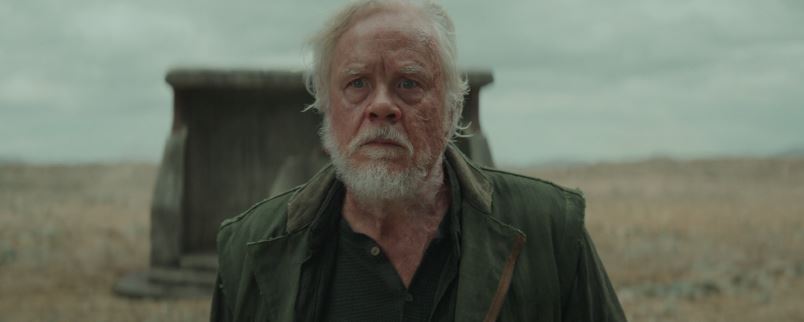
Tim Robbins has spent two seasons as the face of institutional cruelty and a third as something more complicated: a man who enforced a system he no longer trusts. His final walk is quiet. No grand speech. A handshake with Sims. Stairs. Open air. The ridge. The tree that has become the show’s grim landmark. He bleeds, slumps, and the world briefly turns beautiful for him — leaves, light, a last private hallucination — before it does not.
It is not redemption in the cheap sense. Bernard poisoned people. He lied. He kept a prison running. “Farewell” does not ask the audience to forget that. It asks whether a man who finally sees the machine can still matter by stepping in front of it. In this hour, he does.
Then the episode jumps three years.
Daniel Keene and Helen Drew are together. Helen is pregnant. They have taken the NDA money, tried to live outside the project, and now they are back in Georgia for the ceremonial unveiling of Per Stensen’s completed silos. The grounds look like a tech campus on opening day. Guests have assigned numbers. Tours have been arranged. Peter Gabriel — playing himself — is on the bill, assigned with his family to Silo 17. The joke would be funny if the series had not already taught us what happens to Silo 17.
Gabriel soundchecks “Here Comes the Flood” while the important people hover nearby. Senator Thurman rehearses the speech she thinks will define her career. Stensen barely listens. Instead, Colin Hanks sits at Gabriel’s keyboard and plinks out “Chopsticks,” a small, almost throwaway bit of business that doubles as a family joke: Tom Hanks famously played the same tune on the giant FAO Schwarz piano in Big. Here the echo is colder. In Big, the song is wonder. In “Farewell,” it is a trillionaire killing time while the world is about to end, and while a senator still believes she is the one running the show.
Helen is sent to Silo 18. Daniel is steered toward Silo 1. That split is the episode’s loudest alarm, and the characters hear it a few minutes too late.
The Pact already exists. Charlotte treats it like an eccentric artifact. Victor Crnkovich is more candid. AI wrote most of it. He and Anna Thurman edited. The sacred operating system of underground life, the document generations will kill over, began as generated text polished by people who hoped they would never have to find out if it worked.
Daniel notices the rest. Charlotte’s texts do not sound like Charlotte. Reception dies at convenient moments. Henry keeps him close to Silo 1. Helen’s tour includes the kind of specification you only mention if you expect to need it: how close a blast Silo 18 can survive. Both of them try to leave. They climb the berms, find each other across the complex, and get one last look.
Then the horizon opens.
A nuclear flash. A mushroom cloud. A voice — the Algorithm, already present at the birth of the system — ordering everyone into the nearest silo. Daniel is dragged toward Silo 1. Helen, pregnant, is pulled toward Silo 18. The episode cuts before it confirms who makes it inside. It does not need to. The assignment was the point.
The show stops short of an on-screen confession that Stensen or his circle launched the bomb. It does not need a confession. The timing is grotesque. Selected guests. Finished infrastructure. A finished rulebook. A ceremony. Then the sky. Whether the blast is one weapon over Atlanta or the start of something wider, the effect is the same. The contingency becomes the world.
The visual rhyme is exact. Helen stands outside Silo 18 as the old world ends. Centuries later, Bernard dies in that same landscape after deciding the new world was a lie. One watches the doors close. The other walks out after they have been closed too long.
“Farewell” is Season 3 at full strength: patient when it needs to be, ruthless when it finally moves. The split structure gives Robbins a complete last act and gives the Before Times the space to turn from conspiracy thriller into disaster film. Jessica Henwick and Ashley Zukerman sell the dread without speechifying. Colin Hanks’ Stensen remains the most unsettling kind of architect — not a cackling villain, just a man with enough money and certainty to treat civilization as a prototype, and enough casual nerve to noodle “Chopsticks” while the flood is already coming.
The episode also reframes the mythology. If the Pact was drafted by a model and edited by committee, then silo law was never holy. If the Algorithm can sound annoyed, then the voice in the wall may be flesh. Those two ideas do more damage to the show’s theology than any explosion.
What remains for the finale is the hard part. Juliette has Bernard’s theory, a rebellion still working in the dark, and a Safeguard that has not been solved. In the past, Daniel and Helen have been sorted into the two silos that now define the present. “Farewell” does not pretend that answers will be kind. It only insists that the people who built this place, and the people still trapped inside it, were never as separate as the calendar suggested.