


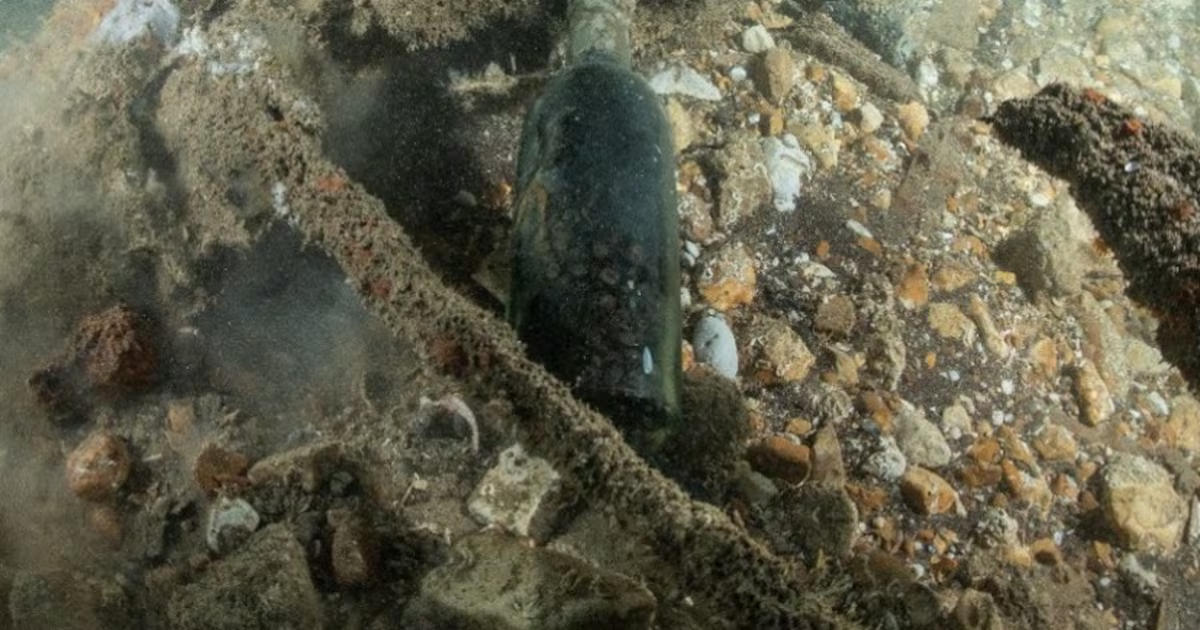
In the cold waters off the English coast near Dover, time has a way of holding its secrets. Last year, Belgian underwater photographer Stefan Panis was exploring a shipwreck when something caught his eye amid the sand and silt. He and fellow diver Eddie Huzzey carefully recovered the object. Only after surfacing and giving it a rinse did the familiar branding emerge: Guinness. The bottle dated to 1864.
That discovery, made on the wreck of the sailing barque Mindora (sometimes recorded as Mindoro), has opened an unexpected window onto one of the world’s most iconic beers. The ship had departed London bound for Vancouver and sank after a collision on November 27, 1864. Among its cargo were bottles of stout—possibly a full case of 24, with more cases potentially still buried nearby. Panis estimates up to around 20 bottles have been located so far, preserved under constant pressure and darkness that create surprisingly favorable conditions for long-term survival.
What makes the find particularly compelling for food lovers and brewing enthusiasts is not merely the age of the liquid, but what it might still contain. Samples from the bottle have been sent to researchers at KU Leuven University in Belgium, including professor of microbiology and genetics Kevin Verstrepen. The divers, working with technical diver and historical researcher Paweł Truszynski, have dubbed the effort “Project Jurassic Beer.” Their goal is ambitious: recover enough genetic material—especially from the yeast—to help recreate the stout as it was brewed more than a century and a half ago.
Living yeast cells are unlikely to have survived, Verstrepen has noted, though the team will still check. The more realistic path involves DNA analysis. If the genetic profile of the original yeast can be mapped with sufficient detail, researchers could identify closely related modern strains—a “sibling” yeast—and use it to re-brew a version as faithful as possible to the 1864 product. Panis has expressed measured optimism: there is always a chance of recovering complete DNA and producing a small re-brew of the exact beer found in those bottles.
The science is grounded in the same principles that have allowed researchers to study historic beers from other wrecks. Yeast is central to a beer’s character—its fermentation produces not only alcohol but a complex array of flavors and aromas. Nineteenth-century brewing practices differed from today’s industrial methods in ingredients, equipment, and microbial cultures. A successful recreation would offer more than novelty; it would provide a tangible connection to the sensory world of Victorian-era drinkers, revealing how the stout’s balance of roasted malt, bitterness, and body may have differed from the Guinness we know now.
There is even speculation that the liquid itself might remain drinkable. Brewing historian Edward Bourke has pointed out that bottles stored upside down can form a pressurized seal from air bubbles, reducing the chance of seawater seeping past the cork. Whether anyone will ever taste the original contents remains uncertain and would require rigorous safety testing. The greater promise lies in the scientific reconstruction.
The divers have contacted Guinness and the company’s archives at St James’s Gate in Dublin to cross-reference findings. The project sits at an intriguing intersection of maritime archaeology, microbiology, and culinary history. For those who appreciate the craft of beer, it underscores how much of a drink’s identity is written in its microscopic life—and how modern tools can sometimes retrieve that writing from the most unexpected places.
Whether “Project Jurassic Beer” ultimately yields a pourable recreation or simply deeper knowledge of 1860s stout production, the discovery already succeeds in one respect: it reminds us that even the most familiar flavors have histories still waiting to be tasted. The next chapter will unfold in the laboratory, where DNA sequences may yet translate into the quiet complexity of a glass raised across 162 years.