


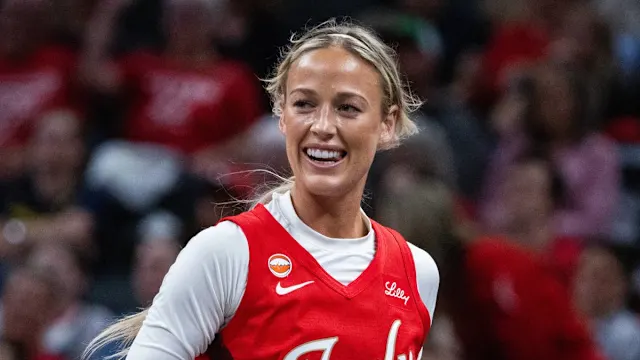
Indiana Fever guard Sophie Cunningham is not backing down.
Ahead of Wednesday’s game against the Connecticut Sun, the 29-year-old reiterated her belief that young girls and women deserve protected spaces in sports and locker rooms, free from competition against biological males. The comments came in response to an ESPN profile that put her views under a national spotlight and sparked sharp reactions across social media.
“I said what I said,” Cunningham told reporters. “I think it’s kind of common sense, and I think I’ll always believe in that. I think it’s really important to protect children, and that’s little girls who are also involved in that category. So I stand on what I said, and I’ll always believe that.”
Genevieve Gluck on X (formerly Twitter): “Sophie Cunningham responds to criticism over her recent comments to ESPN about wanting to protect women’s sports from “biological men.””I said what I said. I think it’s kind of common sense.When it comes just to protecting young girls in sport and women in sport, I feel very… pic.twitter.com/2uh0MWj8zM / X”
Sophie Cunningham responds to criticism over her recent comments to ESPN about wanting to protect women’s sports from “biological men.””I said what I said. I think it’s kind of common sense.When it comes just to protecting young girls in sport and women in sport, I feel very… pic.twitter.com/2uh0MWj8zM
In the ESPN piece, Cunningham made clear she does not hate transgender people. She pushed back against that characterization, saying she aims to “extend love” while also speaking truth. Her priority, she explained, is protecting young girls in locker rooms and in competition who “shouldn’t have to go against biological men.”
She framed the issue as one of morals rather than politics. “I’m not a very political person, but I do have beliefs, I have morals, and I’ll always stand on those and be true to who I am,” Cunningham said. She pointed to Title IX as the foundation that created opportunities for women in sports. Without those protections, she argued, the category itself loses meaning. “If Title IX and women’s sports weren’t protected, then you wouldn’t hear about any type of women in sport.”
The Indiana Fever released a statement supporting her right to speak while emphasizing the organization’s broader values. “Our players are thoughtful adults with their own perspectives and voices, and those views are their own,” a team spokesperson said. “We are committed to welcoming fans from every background and treating everyone with respect, and that’s what guides us as an organization.”
Support for Cunningham’s position came quickly from high-profile voices who have long advocated for sex-based categories in women’s sports. Author J.K. Rowling publicly backed the Fever guard. Former swimmer and women’s sports advocate Riley Gaines also voiced approval, writing that in a world full of Megan Rapinoes, people should “be a Sophie Cunningham.” Fans and commentators on the fairness side of the debate praised her willingness to speak plainly on an issue many athletes have avoided.
Critics labeled the comments transphobic and accused Cunningham of targeting a vulnerable group. Some online voices called her stance “truly disgusting” and rejected the idea that biological sex should determine eligibility in women’s categories. Others argued for inclusion and accused her of aligning with conservative politics despite her insistence that she sits in the middle.
The debate is not new. Multiple states, including Indiana, have restricted transgender girls and women from competing in female sports categories. The NCAA updated its policy in 2025 to limit women’s competition to athletes assigned female at birth. The U.S. Supreme Court has also ruled that states may ban transgender women from girls’ and women’s sports without violating Title IX. Proponents of the restrictions cite fairness, safety, and the integrity of the female category. Opponents emphasize inclusion and note the relatively small number of transgender athletes at elite levels.
Cunningham has grown into one of the WNBA’s most recognizable players since joining the Fever, known for her sharpshooting, physical style, and willingness to protect teammates. Her rising profile has given her a larger platform, and she shows no interest in softening her position to avoid controversy.
For Cunningham, the issue remains straightforward: biological women and girls built opportunities under Title IX, and those opportunities are worth defending. She insists her stance comes from conviction, not politics, and that love and honesty can coexist. Whether that message resonates or draws further criticism, she has made clear she will not walk it back.