


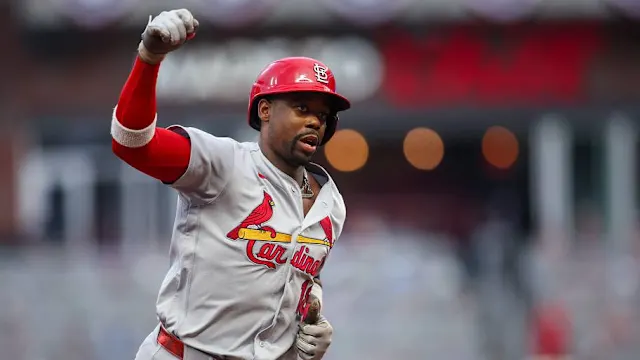
Jordan Walker is no longer a prospect or a project. At 24 years old and in the middle of a genuine breakout season, the Cardinals’ right fielder has become one of the most productive hitters in the National League and a foundational piece of the club’s next competitive window. Extending him before arbitration escalates the cost is the smart, proactive move for a franchise that has already shown willingness to invest in its young core.
Walker’s 2026 numbers make the case plainly. Through mid-to-late July he is batting .289 with 22 home runs and a National League-leading 76 RBIs. His .868 OPS ranks among the better marks in the league, and he has added 14 stolen bases while playing everyday right field. Those are not empty counting stats. The power is real, the run production has been consistent, and the overall package has carried the Cardinals’ offense for stretches of the season. He earned an All-Star nod and capped the first half by winning the Home Run Derby, turning himself into a national name overnight.
The transformation is more than a hot streak. After uneven results in his first two-plus seasons, Walker made clear mechanical and physical adjustments. The swing decisions have improved. The strikeout rate, once a glaring concern, has settled into manageable territory. Defensively, the former third baseman has become a legitimate asset in right field, with improved range and an arm that grades out as a weapon. What was once projected as raw tools has developed into a complete, everyday major-league profile.
The control window makes the timing favorable. Walker is under team control for three more seasons after 2026 and becomes arbitration-eligible in 2027. That gives the Cardinals cost certainty through 2029 if they choose to keep him on year-to-year deals. But arbitration will ramp up quickly if he continues producing at this level, and free agency arrives after the 2029 season. Waiting risks paying significantly more for the same player—or losing him entirely.
A useful recent parallel is Pete Crow-Armstrong’s extension with the Cubs. In March, Chicago locked up its 24-year-old center fielder on a six-year, $115 million deal that begins in 2027. The structure buys out Crow-Armstrong’s arbitration years and two free-agent seasons, keeping him under control through 2032. It includes a $5 million signing bonus, salaries of $10 million annually from 2027-29, $20 million in 2030, and $30 million in each of 2031 and 2032, plus MVP escalators that could push the total higher. The Cubs acted while Crow-Armstrong was still pre-arbitration and before his value fully exploded in the open market.
Walker presents a similar profile: same age, elite production in a breakout season, and several years of remaining control. The Cardinals do not need to match the exact structure or dollar figure of Crow-Armstrong’s deal, but the principle is identical. Securing a multi-year commitment now, while leverage still favors the club, buys out rising arbitration costs and captures early free-agent years at a discount relative to what the market will demand later. It also creates roster and payroll certainty as St. Louis builds around a young position-player core that already includes JJ Wetherholt and others.
Skeptics will note Walker’s earlier struggles and still-elevated strikeout totals. Those concerns belong in any negotiation. The evidence in 2026, however, points to a player who has figured out major-league pitching and continues to improve. The tools that made him a first-round pick in 2020 and one of baseball’s top prospects are finally translating on a consistent basis.
The Cardinals have watched high-upside players develop elsewhere or become too expensive to retain. Walker is the type of talent franchises build around. Extending him while the control window remains favorable—and while comparable young outfielders are already commanding nine-figure guarantees—is the responsible baseball decision. The production is there. The age is right. The market has set a clear precedent. It is time to get a deal done.