


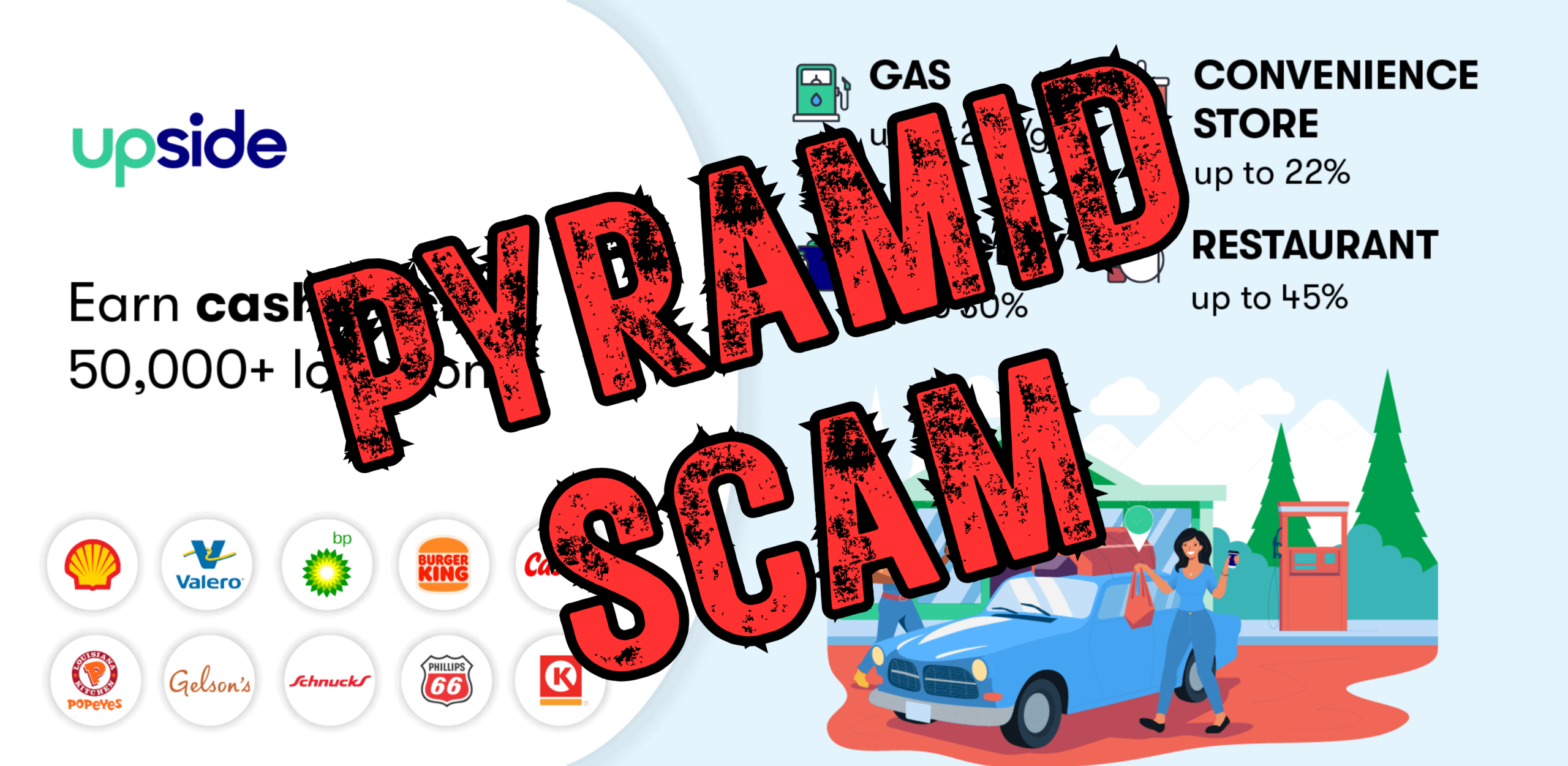
The Upside app (formerly GetUpside) markets itself as a simple cash-back tool for gas, groceries, and restaurants. You download it, claim offers at participating stations or stores, verify your purchase (often by uploading a receipt or linking your card), and earn a few cents per gallon or a percentage back. It sounds harmless—another app to give you a little relief in a high-cost economy.
In reality, the app’s core engine is its aggressive referral program. That’s where the real money for them comes from, and that’s why it functions like a classic pyramid scheme.
How Upside Really Works: Referrals Over Everything
- New users enter a referral code for an initial bonus (often 15¢/gallon extra on the first fill-up plus other perks).
- The referrer earns ongoing passive income: typically 1¢ per gallon every time the referred person buys gas through the app—potentially “forever.”
- Heavy promoters are encouraged to share codes widely to build a downline of users whose purchases fund the referrer’s earnings.
- If you are an Instacart Diamond Shopper you get an additional 25¢/gallon cash back.
This creates a structure where early or aggressive recruiters can earn far more from their network than from their own purchases. The company has historically pushed this hard—users were incentivized to post codes on social media, bumper stickers, and more. The company even sent you business cards with your code on it to pass around.. I still have multiple boxes of them. Later, they apparently quietly tightened rules: they capped the cashback on groceries and gas, referrals are now supposedly limited to “friends and personal acquaintances,” with account bans for public sharing.
This is textbook multi-level marketing behavior. The product (cash back) exists, but the real growth and incentives come from recruiting more participants. When the user base expands through endless referrals, the company benefits from more transaction data, retailer partnerships, and fees—while many users chase unsustainable referral income. Past changes to referral terms even sparked a class-action lawsuit alleging the company reneged on promised lifetime bonuses after users had already promoted it heavily. There were commercials on the radio what seemed like every 15 minutes, with the radio station’s code.
The Trap: They Can Shut You Down Anytime
Apparently now, the Terms of service have changed to explicitly prohibit widespread sharing of your personal referral code. You’re allowed limited personal social media posts, only if your account has fewer than 2,500 followers (I now have 7,300). Public dissemination, ads, blogs, or “widespread use” can get you flagged for violating the referral program.
I learned this the hard way. Nearing 300 referrals—real people who signed up and used the app—I shared my link on my personal Facebook profile. Not a massive public campaign, just my own profile and in response to people complaining about high gas prices. Upside permanently suspended my account. All that effort, all those accumulated rewards, and the passive income stream? Gone. No appeal restored it. They just decided it was an “abusive” promotion, even on a personal profile and said the decision is ‘Final.” Now they ignore my support ticket emails.
This isn’t rare. Complaints across forums, BBB, and review sites detail sudden suspensions for referral activity, multiple accounts (even accidental), or other vague “fraudulent” behavior. Suspended users often lose pending cash-outs like myself with about $50 sitting in my account, and the company has broad discretion to terminate accounts and forfeit rewards.
Over the years of using the app, I have made over $2,100 cash back… but all the residual income, Instacart savings, etc…. gone.
Why This Matters: It’s Not Worth the Risk
- Time sink with low real returns: The cash back on your own purchases is modest at best. The big earnings come from building a referral army—which they can dismantle overnight.
- Pyramid dynamics: Your “passive” income depends on others continuing to fuel up through the app. When growth slows or rules change (as they have before), the house of cards wobbles.
- Arbitrary enforcement: One day you’re a top referrer earning extra; the next, you’re banned for doing exactly what the app once encouraged.
- Opportunity cost: Better, more transparent cash-back options exist without the MLM-style pressure and ban risk.
Upside isn’t illegal, but it preys on the same psychology as pyramid schemes: dangling easy passive income through recruitment while holding all the power to cut you off. The app collects your purchase data, location, and habits regardless.
Through the past several years of using it, my gas business has almost 100% gone to Circle K and Caseys because that’s who their deals are with, at least locally… but now my business will go elsewhere, especially where it is more convenient.
Bottom line: Delete Upside. Don’t download it. Don’t share codes. Save your time and energy for apps that reward actual use, not endless recruiting. If something sounds too good to be true—and depends on getting hundreds of friends to join—treat it like the trap it is. Your wallet (and peace of mind) will thank you.