


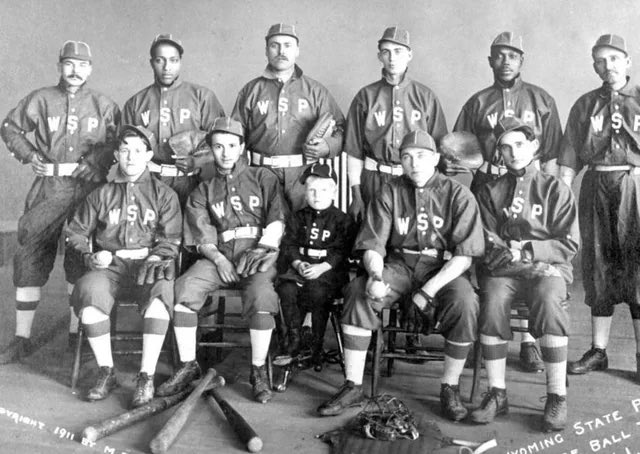
In the summer of 1911, a remote Wyoming prison yard transformed into one of the most high-stakes ballparks in American history. The Wyoming State Penitentiary All-Stars—better known as the “Death Row All-Stars” or simply “the Cons”—were no ordinary team. Assembled from murderers, rapists, thieves, and forgers serving time at the state penitentiary in Rawlins, they took the field under a chilling bargain from Warden Felix Alston: keep winning, and your executions (or long sentences) would be delayed. Lose, and the gallows loomed closer.
The team was the brainchild of Alston, a reform-minded warden who took over in April 1911 after the previous administration’s brutal “broom factory” labor system was shut down by state lawmakers. Alston believed baseball could boost inmate morale and give the public a spectacle in baseball-mad Rawlins. He handpicked 12 convicts aged 18 to 39, outfitted them in crisp new uniforms, and let them practice inside the prison walls. Their coach and captain was George Saban (inmate No. 1441), a convicted murderer serving 25 years for his role in the infamous Spring Creek raid, where sheepherders were ambushed and killed. Saban, a close friend of the warden, never played due to missing fingers but ruled the dugout with an iron fist.
The roster read like a frontier wanted poster. Star right fielder Joseph Seng (inmate No. 1612) was under a death sentence for first-degree murder after shooting a railroad detective in a jealous dispute. Pitcher Thomas Cameron, a 20-year-old with a blazing fastball, was in for sexual assault. Other standouts included shortstop Joe Guzzardo (manslaughter), first baseman Eugene Rowan (rape), and center fielder Sidney Potter (forgery). The lineup also featured three rapists, five thieves, and additional killers—hardened men who understood that every at-bat could literally buy them another day of life.
Alston’s deal, relayed through Saban, was blunt: victories would earn stays of execution and sentence reductions. Errors that cost games could mean added time—or worse. Saban warned the players that “individual errors that cost the team the win… would result in death.” The inmates played with desperate intensity, knowing the town’s gamblers and even prison officials had skin in the game.
Their opponents were always the same: the Wyoming Supply Company Juniors (also called the Rawlins Juniors), one of the strongest amateur teams in the region. The All-Stars dominated in four straight exhibition games that drew huge crowds and national headlines:
- July 18, 1911 (prison yard): 11-1 win. Seng launched two home runs, including a grand slam. The Washington Post ran the headline “Slayer Scores Home Runs.”
- August 5, 1911: 11-1 win. Seng went 4-for-4 with flawless fielding.
- August 13, 1911: 11-4 win. Cameron struck out 14 while allowing just six hits.
- August 29, 1911 (Overland Park, under heavy guard): 15-10 win. The first (and only) public game outside the prison walls.
Local newspapers raved about the “odd” but thrilling spectacle. The Carbon County Journal praised Seng’s “classy game” and noted his pending petition for commutation to life imprisonment. Prisoners even sold lemonade to fans during the sweltering afternoons.
But behind the cheers was something darker: rampant gambling. Rawlins was betting-crazy, and the All-Stars became the hottest wager in town. Saban moonlighted as a bookie, pocketing a 20% cut while feeding gamblers “inside information” about the players’ incentives. Guards, politicians, ranchers, and bar patrons poured money on the Cons. Warden Alston himself faced whispers of betting with prison funds. The high stakes turned the diamond into a pressure cooker—players knew the town’s bets were riding on their lives.
The winning streak lasted exactly four games. In September 1911, Governor Joseph Carey—already cracking down on gambling statewide—pressed Alston to shut it down. The governor worried about the optics of a “play-to-pay” scheme that appeared to shorten sentences for athletic performance and the flood of illegal bets tied to the games. Alston announced the team was finished, redirecting focus to a new education program for inmates. The All-Stars turned in their uniforms and bats. The experiment was over.
Aftermath was mixed. Most players served out their sentences or were paroled within a year or two. Seng, the star whose home runs had bought him time, was denied clemency. He was hanged on May 24, 1912—the first execution at the penitentiary’s new gallows—in front of a crowd of reporters. He walked to his death “in a manner which stamped him as a brave man,” according to the Carbon County Journal. Saban later escaped prison in 1913.
The short-lived saga of the Wyoming State Penitentiary All-Stars has since been chronicled in books such as The Death Row All Stars: A Story of Baseball, Corruption, and Murder (2014) by Howard Kazanjian and Chris Enss. It remains one of the strangest footnotes in baseball—and American criminal justice—history: a team that literally played for its life, went undefeated, and vanished when the gambling and politics became too much even for frontier Wyoming.
In an era when prisons were harsh and public entertainment raw, the All-Stars proved that for a handful of desperate men, America’s pastime wasn’t just a game—it was a temporary reprieve from the noose. Four wins bought them a summer. Then reality returned to Rawlins.