


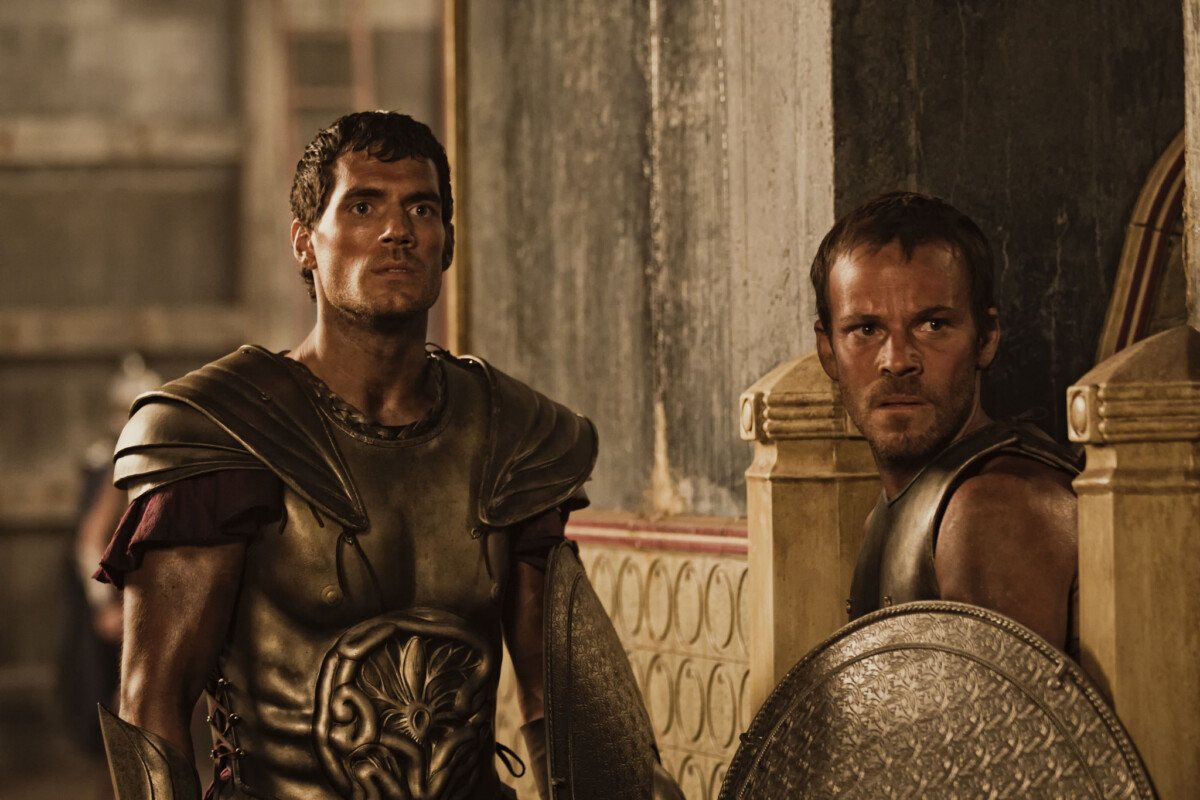
Fifteen years after its release, Tarsem Singh’s Immortals remains one of the more striking examples of early-2010s mythological spectacle. A rewatch today confirms both its enduring visual power and the limitations that kept it from achieving the lasting cultural footprint of its closest contemporary, 300. It is also, for many viewers, an early showcase of Henry Cavill’s leading-man presence—one that made the case for him as Superman well before Man of Steel arrived.
Set in a heightened, almost operatic version of ancient Greece, the film follows Theseus (Cavill), a peasant warrior secretly guided by the gods, as he confronts the ruthless King Hyperion (Mickey Rourke). Hyperion seeks the legendary Epirus Bow so he can free the imprisoned Titans and wage war on both humanity and Olympus. Freida Pinto’s oracle Phaedra, Stephen Dorff’s thief Stavros, and a supporting pantheon that includes Luke Evans’ Zeus and John Hurt’s disguised elder complete the ensemble. The story is a freewheeling, heavily stylized take on Greek myth rather than a faithful retelling.
What continues to distinguish the film is Singh’s visual approach. Coming off the more personal The Fall, he brings a painterly, baroque sensibility to the material: vast landscapes, elaborate costumes, dramatic compositions, and action that favors balletic slow-motion and precise framing over chaotic cutting. The gods appear as gleaming, idealized figures; the Titans and Hyperion’s forces carry a more grotesque weight. Even in an era of ubiquitous high-end CGI, the film’s aesthetic still registers as distinctive rather than generic. Roger Ebert’s contemporaneous assessment that it was “the best-looking awful movie you will ever see” remains apt—the craft is undeniable even when the storytelling is not.
Cavill’s performance is the other element that has aged especially well. He brings physical authority and a quiet intensity to Theseus that already suggested a capacity for larger-than-life heroism. Contemporary reviews noted his presence and physique; in hindsight, the role functions as an effective audition for the kind of mythic leading man he would soon play. Rourke, by contrast, leans into pure menace, delivering a snarling, larger-than-life villain whose commitment matches the film’s heightened tone. The supporting cast is solid but largely in service of the imagery.
The narrative remains the weakest element. The plot moves in broad strokes of revenge, destiny, and divine non-interference, with dialogue that is frequently stilted and character development that stays thin. Romance and alliances feel more obligatory than organic. These shortcomings were widely noted in 2011 (the film sits at roughly 50% on Rotten Tomatoes and in the mid-40s on Metacritic) and have not improved with time. In an age of denser superhero storytelling and more sophisticated franchise mythology, the script’s simplicity is more conspicuous.
Viewed today, Immortals works best as pure visual and action spectacle rather than as a cohesive mythological drama. Its commercial success at the time (roughly $227 million worldwide on a $75 million budget) made sense; the imagery was the draw. It has since been reassessed by some as an underrated example of stylized fantasy, particularly for viewers who prioritize directorial vision and design over narrative rigor. The action sequences still deliver, and the film’s commitment to a singular aesthetic gives it more personality than many subsequent digital epics.
Immortals does not transcend its origins as a stylish, violent myth-infused blockbuster, but it holds up as a memorable piece of cinematic design. Cavill’s star quality is clearer than ever in retrospect, and Singh’s eye continues to justify the film’s existence even when the story does not. For those who enjoy heightened, painterly spectacle, it remains worth revisiting—less for what it says than for how it looks.