


Searching for an early Patrick Stewart performance can lead down some unexpected paths. Lifeforce, Tobe Hooper’s 1985 science-fiction horror film, is one of the strangest and most ambitious of them. Adapted by Dan O’Bannon and Don Jakoby from Colin Wilson’s novel The Space Vampires, it is less a conventional genre exercise than a big-budget fever dream that collides alien invasion, vampirism, body horror, and a full-scale London apocalypse into a single, unapologetically excessive package.
The setup is pure pulp. A joint British-American shuttle mission investigating Halley’s Comet discovers a massive alien craft and recovers three humanoid figures held in suspended animation. Once on Earth, the beings—most memorably the near-constantly nude “Space Girl” played by Mathilda May—prove to be life-draining entities that leave their victims as desiccated husks. Those victims, in turn, rise and spread the contagion, turning much of London into a landscape of marauding, energy-starved zombies. Colonel Tom Carlsen (Steve Railsback), the mission’s sole survivor, develops a psychic and erotic link to the female alien, while SAS officer Colin Caine (Peter Firth) and scientist Hans Fallada (Frank Finlay) try to contain the outbreak. The film steadily escalates from space mystery to medical thriller to urban catastrophe, climaxing in a spectacularly over-the-top confrontation at St. Paul’s Cathedral.
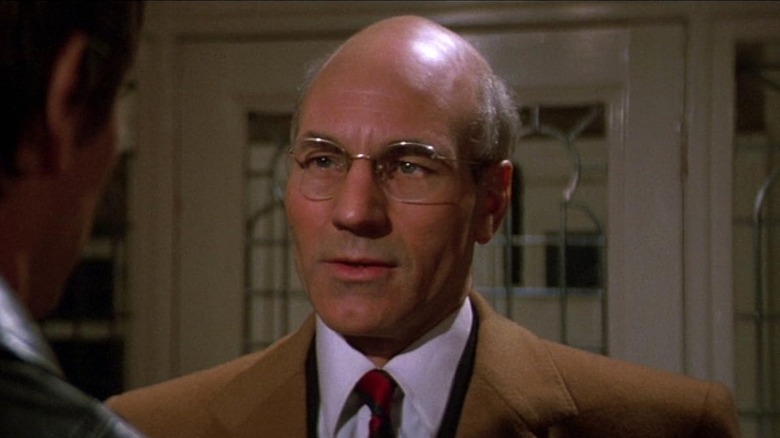
Stewart appears in a supporting but indelible role as Dr. Armstrong, the director of a psychiatric hospital who becomes possessed by the alien force. He plays the part with absolute commitment, delivering the material straight even as the scene veers into the bizarre—most famously in a sequence that includes what was, at the time, his first on-screen kiss. The performance is a small masterclass in treating the ridiculous with total seriousness, which is precisely the tone the film needs.
Hooper, coming off Poltergeist and still best known for The Texas Chain Saw Massacre, directs with a mixture of classical British horror atmosphere and pure Cannon Films excess. John Dykstra’s visual effects, practical creature and shrinking-body work, and Henry Mancini’s grand, operatic score give the picture a scale and polish that belies its delirious content. Mathilda May’s largely wordless, physically commanding presence anchors the erotic and predatory core of the story, while the supporting British cast (Firth, Finlay, and others) supplies a veneer of institutional competence that makes the escalating madness funnier and more unsettling.
The film is not without flaws. The plot grows increasingly incoherent in the middle stretch, the American theatrical cut (trimmed to roughly 101 minutes from a longer international version) feels rushed in places, and Railsback’s intensity sometimes tips into overacting. Critics at the time were largely unkind, dismissing it as hysterical or pornographic; it underperformed commercially on a reported $25 million budget. Viewed now, those same qualities—the tonal whiplash, the unembarrassed sexuality, the willingness to stage a zombie apocalypse in contemporary London with practical effects and a full orchestral score—make it feel like a rare artifact of an era when a major genre director could still be handed serious resources for something this idiosyncratic.
Lifeforce is not subtle, and it is not for everyone. It is, however, genuinely memorable: a cult classic that earns its reputation by committing fully to its own excess. For anyone who sought it out specifically for Stewart, his brief but unforgettable turn is reason enough; the rest of the film supplies a wild, visually rich, and frequently ridiculous ride that has only grown more appealing with age.