


Spoiler warning: This recap and review discusses major plot points from the November 20, 2026 episode.
In “Young Blood,” the fourth episode of Dexter: Resurrection Season 2, the series leans hard into its most persistent theme: the corrosive weight of fathers and sons. Dexter Morgan (Michael C. Hall) finds himself facing a young killer whose circumstances mirror his own deepest fears about Harrison, while the New York Police Department continues to flail against a serial predator who treats the city as his personal stage. The result is a character-driven hour that prioritizes moral ambiguity and personal reckoning over pure procedural thrills, though it still delivers a grimly efficient kill and a pointed cliffhanger.
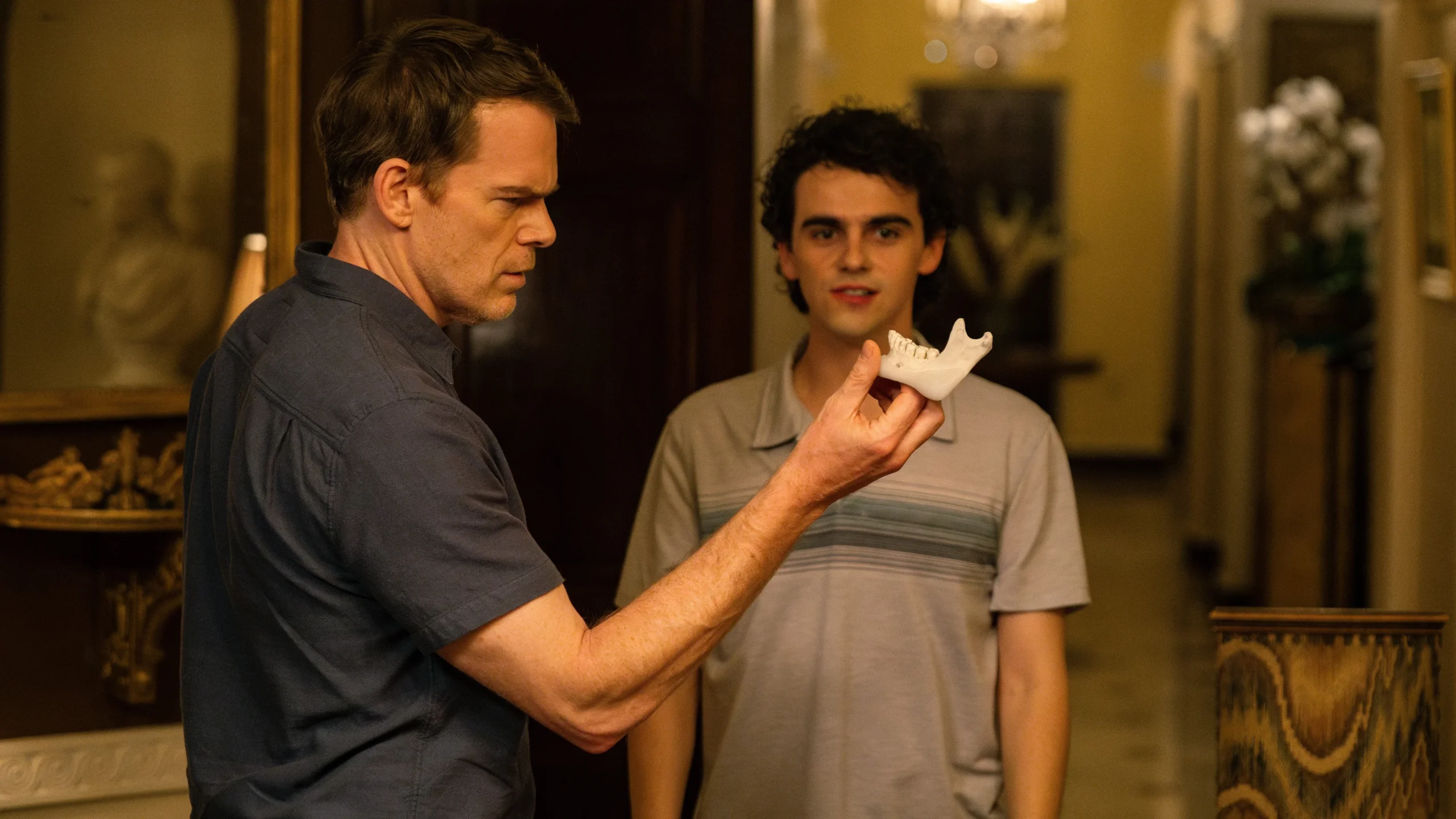
The episode’s central thread begins with Dexter and Charley (Uma Thurman) targeting the last remaining member of Leon Prater’s former serial-killer circle: the JawSplitter, a 70-year-old predator from Fresno who drains victims of their blood in a grotesque bid for youth and removes their jaws while they are still alive. Instead of the aging killer they expect, a 21-year-old named John Thomas Jr.—JJ, played with manic energy by Jack Dylan Grazer—arrives at the arranged meeting. His father has been dead for two years; the last four murders belong to him. Dexter, posing as the Dark Passenger, hesitates. Harry’s Code requires that he kill only those who kill for the pleasure of it, and JJ may simply be a product of his father’s grooming.
What follows is an extended sequence of Dexter probing the young man across New York, searching for evidence that JJ is a true predator rather than a damaged child. The parallels are deliberate and uncomfortable. Dexter once tried to steer Harrison toward his own path; JJ’s father took him on a kill at 14 and used him as both apprentice and blood source. When JJ casually reveals that he murdered his own father for becoming “sloppy” and has kept the jaw as a trophy, the ambiguity collapses. Dexter administers the syringe and finishes the job on his table. The kill carries a quieter, almost reluctant tone than usual—Dexter clearly wanted a different outcome. Afterward, he disposes of the body in the Hudson, granting JJ a final, ironic wish to remain on the water.
Parallel to this, Harrison’s nascent career with the NYPD is tested by the Five Borough Killer. After the killer announces a death on the subway, officers flood a Bronx station. Harrison and his partner Mixon respond to a purse snatcher; the chase leaves Harrison briefly in danger before Mixon intervenes and they secure the arrest. Later, the FBK poisons a homeless man with thallium in plain sight of police, then AirDrops the footage as a taunt. Detectives Wallace and Oliva also learn the killer purchased his burner phones eight years earlier, underscoring a level of long-term planning that makes him nearly impossible to catch. Harrison’s growing disillusionment is explicit: the system cannot stop these monsters, so perhaps his father can. He gives Dexter his blessing to pursue the New York Ripper and even offers assistance, reversing an earlier boundary.
Charley’s arc provides a quieter counterpoint. With the Prater list essentially cleared, she signals her intention to leave. Dexter’s attempt to prolong their partnership—and the understanding that comes with it—is gently rebuffed. Harry’s ghost frames the separation as potentially healthy, but the isolation is palpable. The episode closes with a knock at Dexter’s door. He opens it and asks, stunned, “You’re alive?” The visitor remains unseen, with popular speculation centering on Mia LaPierre / Lady Vengeance (Krysten Ritter) from Season 1. Who do you think it might be?
“Young Blood” succeeds most when it treats the Code as a flawed, self-serving framework rather than a clear moral compass. Dexter’s reluctance to kill JJ is not abstract philosophy; it is self-recognition. Grazer’s performance as the eager, almost performatively online successor gives the hour its sharpest energy, while Hall continues to convey the accumulating cost of Dexter’s double life through small physical and verbal hesitations. The FBK and Ripper threads remain more functional than compelling at this stage, functioning primarily as pressure on Harrison, yet the subway sequence and the AirDrop taunt effectively illustrate institutional futility.
The episode is not the season’s most explosive, but it is one of its most purposeful. By forcing Dexter to articulate why one young killer must die while another (his son) must be protected, Resurrection continues to interrogate the original series’ central contradiction: the idea that controlled violence can ever remain controlled once it is passed between generations. The final door-knock ensures the question will not stay theoretical for long.