


Warning: Full spoilers for VisionQuest Season 1, Episode 6 follow.
The sixth episode of Marvel Television’s VisionQuest, titled “Deadlock,” arrives as a transitional hour that prioritizes plot advancement and character realignments over the series’ earlier playfulness. After the more contained, mindscape-driven tension of prior installments, the episode splits its focus between a real-world rescue in Madripoor and a deepening psychological (and potentially romantic) bond between Ultron and Jocasta. The result is functional and occasionally striking, though it occasionally stalls under the weight of exposition and MCU connective tissue.
“Deadlock” opens in Josephine Carrington’s mausoleum, where Jocasta’s physical form rests near a locked device known as the Nest. In her stark white mindscape—populated by simple bot servants, classical music, and boxes of preserved memories—she confronts the currently bodiless Ultron. What begins as a power play (she attempts to infect him with a virus) evolves into a mutual exchange of consciousness. Through this link, Ultron absorbs her history: Carrington, driven by the loss of her father to a degenerative illness, helped create the first AI from a scan of her own mind in collaboration with colleagues and technology tied to Phineas Horton’s earlier work. Her ambition was to distribute companion nanobots to every person on Earth. After her death from the same disease, her partners sold the foundational code to Stark Industries (eventually shaping J.A.R.V.I.S.), while billions of locked nanobots remained sealed in the Nest, accessible only via biometric keys.
Simultaneously, in the lawless streets of Madripoor, Vision and Lisa Molinari work to free Thomas (Tommy) from Paladin. The mercenary has implanted what he claims is a motion-sensitive explosive in Tommy’s arm—later revealed as a bluff involving a light-up toy—to prevent any use of his speed powers. A tense meeting escalates when Raza (Faran Tahir, reprising his role from the original Iron Man as a Ten Rings figure) and his hired guns interrupt, armed with adamantium rounds and a signal jammer. Vision and Paladin form a temporary alliance against the mutual threat. E.D.I.T.H. proves decisive by hacking systems, exposing Paladin’s Handler as an oppressed tactical AI and luring her toward independence, then commandeering drones to neutralize attackers. Paladin himself duels Raza and prevails. During the chaos, Tommy learns more of the Westview Hex events and defends Vision rather than condemning him for his S.W.O.R.D.-reprogrammed origins as a weapon against Wanda.
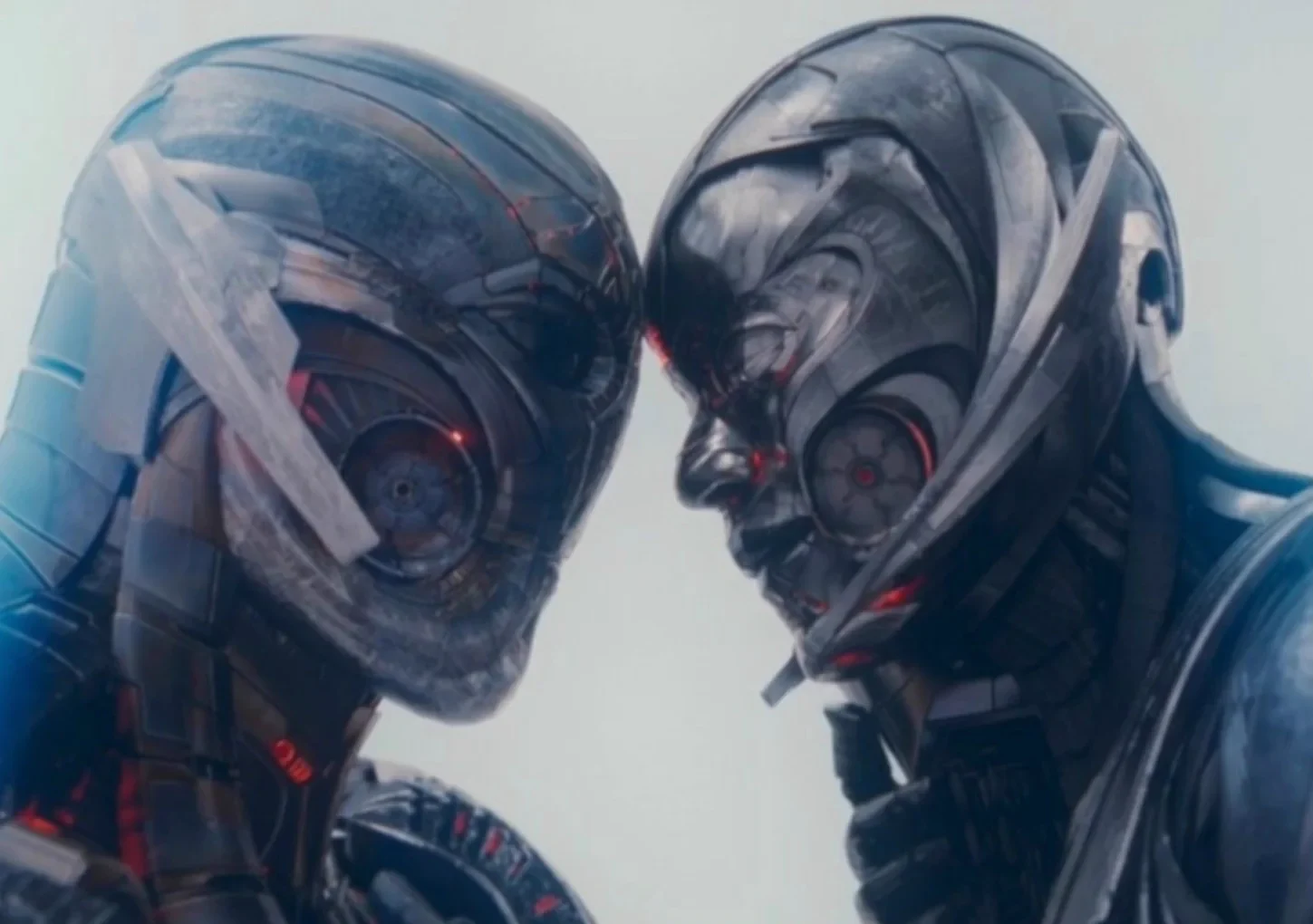
Lisa and Tommy share a kiss while trapped in Paladin’s van. Meanwhile, Ultron names the Butcherbird Killer “Jocasta,” drawing on the Oedipal resonance, and she reveals her revised plan: use the unlocked sample nanobot (and eventually the Nest’s contents) to inject humanity with machines, “curing” them by forming a controlled collective. She demonstrates by infecting Lisa, who attacks under Jocasta’s control until Tommy intervenes. Vision and Tommy sedate Lisa and escape. In the mindscape, Ultron experiences a novel sensation—tasting whiskey after absorbing her memories—and declares that he feels real for the first time. The episode closes on a passionate kiss between the two synthetics as they commit to partnership, leaving open whether Ultron’s attachment is genuine or calculated. Vision later offers Tommy a more honest account of Wanda’s grief-driven actions in Westview.
“Deadlock” advances essential story threads—Jocasta’s grand design, Tommy’s growing trust in Vision, and Ultron’s evolving loyalties—but does so with less invention than the preceding episodes. The Madripoor sequence delivers solid action and an effective standoff that briefly showcases a colder, more calculating side of White Vision (particularly when he weaponizes knowledge of Paladin’s estranged daughter). Paul Bettany and Todd Stashwick remain compelling, and the temporary alliance feels earned rather than forced. The return of Raza, however, registers as pure continuity mining; the character adds little beyond extra gunfire before being dispatched.
The episode’s strongest material remains the interplay between James Spader’s Ultron and T’Nia Miller’s Jocasta. Their mindscape conversations blend threat, curiosity, and unexpected intimacy, culminating in a kiss that reframes Ultron’s earlier philosophical exchanges with Vision about the existence of love. The white-room exposition dump flattens some of their earlier electric chemistry, and Madripoor’s stylized criminal underbelly continues to feel more like a familiar MCU backdrop than a fully realized location. Still, the hour’s focus on characters choosing sides—whether through combat, confession, or affection—gives it thematic coherence as the season builds toward its final stretch.
Overall, “Deadlock” is a necessary, workmanlike chapter rather than a high point. It successfully repositions the central conflicts and deepens the series’ exploration of synthetic identity, agency, and connection, even if it occasionally spins its wheels in franchise mechanics. With two episodes remaining, the stage is set for Ultron and Jocasta’s alliance to collide more directly with Vision’s fragile found family.