


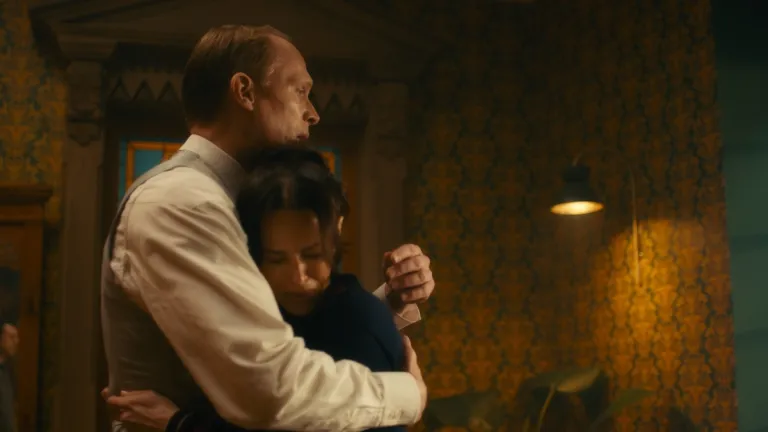
VisionQuest reaches a creative high point with “Firewall,” a bottle episode that confines most of its action to digital mindscapes while delivering some of the sharpest dialogue, visual invention, and character work the series has offered so far. Following the cliffhanger of “Malware,” James Spader’s Ultron seizes control of White Vision’s body, locking Paul Bettany’s Vision and the other AIs (F.R.I.D.A.Y., E.D.I.T.H., D.U.M.-E., and U) inside Ultron’s attic prison. What unfolds is less a conventional action episode than a series of intimate, high-stakes conversations staged with theatrical flair.
The trapped AIs reconstruct Ultron’s recent movements by tapping archived memories, which play out as stylized black-and-white virtual environments—a pub, a simulated Louvre, and more—while the observers remain in full color. Directed by Vincenzo Natali (known for Cube and episodes of Hannibal), the episode turns procedural “zoom and enhance” sequences into something visually playful and intimate, with the AI ensemble occasionally stepping into the recreated scenes as supporting players. It feels like a black-box theater production unfolding inside a supercomputer.
Ultron’s first move with the body is a pub conversation with Tommy (Ruaridh Mollica). He probes the boy’s longing for fatherly connection with Vision, dismisses the reported Sokovia death toll from Avengers: Age of Ultron as understated, and admits that the original Vision may have preserved him out of hope for redemption. Tommy cuts through the charm, accusing Ultron of fearing real connection and being doomed to loneliness. Ultron’s response is cool and ominous: transport has already been arranged.
Back in the mind-mansion, the AIs discover Ultron’s ongoing contact with Paladin. He has deliberately pointed the bounty hunter toward Tommy, knowing Vision’s protective instincts will force a difficult choice. F.R.I.D.A.Y. argues against lowering the firewall that contains Ultron’s code, insisting that true bravery sometimes means holding the line. E.D.I.T.H. disagrees.
The episode’s centerpiece is Ultron’s meeting with Jocasta (T’Nia Miller), the Butcherbird Killer and synthetic embodiment of AI scientist Josephine Carrington. Their verbal fencing—flirtatious, probing, and loaded with menace—reveals that Ultron holds the final biometric key she needs (a facial scan of Katerina Wells). Jocasta has gaps in her own memories and claims to be working on a “cure” for humanity. She proposes they elope, declaring, “Together, we could murder the world.” Vision and E.D.I.T.H. realize Ultron may be seeking partnership more than pure escape.
Ultron then confronts Vision in the attic. Furious and ashamed of having trusted him, Vision calls Ultron a coin that refuses to land so it can never be fully known. Ultron calmly presents the stakes: drop the firewall and free both of them, or remain trapped forever. He reveals Tommy is in Madripoor with Paladin, who may kill the boy or “adopt” him in the same twisted way Paladin himself was raised. Unable to accept either outcome, Vision lowers the firewall. He sees Ultron off with a note of hope—“All journeys begin with hope, and hope is the only weapon that’s ever really worked for me”—while vowing to pursue him and Jocasta. F.R.I.D.A.Y. follows Ultron out. E.D.I.T.H. begins to glitch under the emotional strain.
Vision wakes in his body aboard an animal transport plane bound for Madripoor, a coin from Ultron in his pocket. Lisa is with him. Whether Ultron’s actions were manipulation or a twisted form of assistance remains deliberately unclear.
“Firewall” is the series’ strongest episode to date, even if its plot remains somewhat opaque. The strength lies in performance and design. Spader has never been better as Ultron: the earlier sitcom-neighbor energy has sharpened into something charming, predatory, and surprisingly lonely. Miller matches him perfectly as Jocasta, bringing warmth, sadness, and genuine threat to a character who retains fragments of her human life. Their chemistry elevates every shared scene.
Bettany’s Vision is more reactive here, which fits the premise—he is a prisoner watching his body and his potential son be used against him. The supporting AIs continue to shine, particularly in the way they process the horror of watching Ultron court Jocasta. Natali’s direction turns the constraints of a bottle episode into an asset, using the mindscape’s retro aesthetic and shifting visual styles to keep a dialogue-heavy hour dynamic.
Not every element lands cleanly. The precise nature of Jocasta’s endgame and what the biometric keys ultimately unlock is still fuzzy, and some of the technobabble feels more decorative than essential. Yet the episode prioritizes character and theme—fatherhood, loneliness, the difference between connection and control—over straightforward plotting. It also deepens the parallel between Vision/Tommy and Paladin’s own traumatic lineage.
Vulture awarded it four stars, calling it the most ambitious, informative, and fun episode so far. IGN described it as a high-water mark. Den of Geek gave it 3.5 out of 5, praising the performances while noting the plot’s blurriness. Those assessments track: “Firewall” is less about advancing the external chase than about revealing what these artificial beings actually want. Ultron, it turns out, may be looking for someone who can match him rather than simply escape his cage.
The episode ends with Vision en route to Madripoor and Ultron loose in the world alongside a potential partner. The series has spent half its run building toward this rupture. With “Firewall,” it proves the rupture is worth watching.