


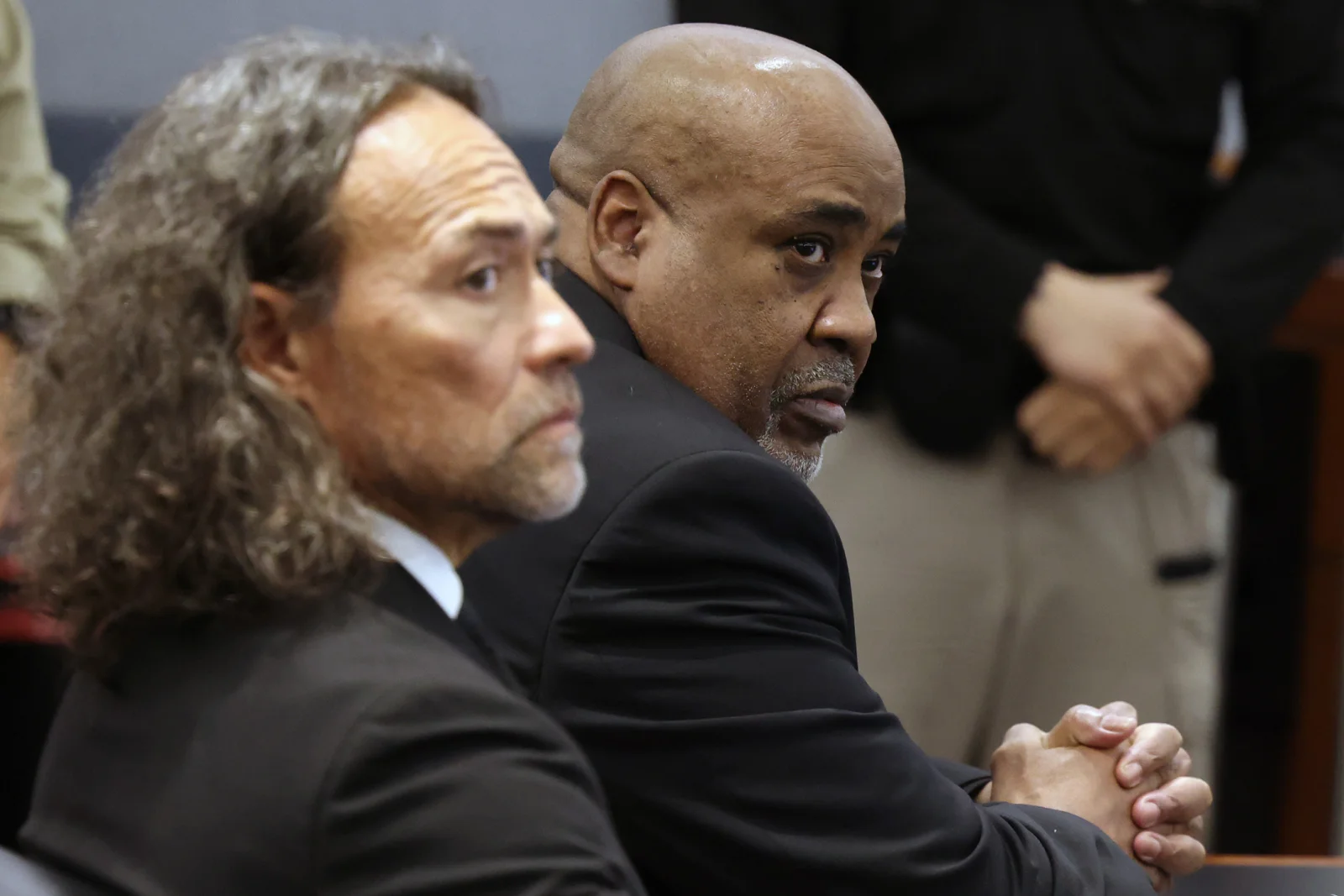
Nearly 30 years after one of hip-hop’s most closely examined killings, a Clark County jury on Monday convicted Duane Keith “Keffe D” Davis of first-degree murder in the 1996 drive-by shooting of Tupac Shakur.
The 12-member jury deliberated about three hours after a weeks-long trial before finding Davis, 63, guilty of murder with a deadly weapon. He is the first — and so far only — person ever charged in the case. Sentencing is set for Oct. 13. He faces a possible life sentence and has already told the court he intends to appeal.
Shakur’s sister, Sekyiwa “Set” Shakur, was in the courtroom as the verdict was read. Family members embraced and wiped away tears. Davis stood largely expressionless, then raised a fist as he left and asked the judge about personal property seized in the investigation.
Tupac Shakur, then 25 and at the height of his fame after *All Eyez on Me* and the Death Row era, was riding in the passenger seat of a black BMW driven by Death Row Records co-founder Marion “Suge” Knight on the night of Sept. 7, 1996. Hours earlier, both men had been at the MGM Grand after a Mike Tyson fight. In the casino lobby, Shakur and members of his circle confronted and beat Orlando “Baby Lane” Anderson, Davis’s nephew and a member of the South Side Compton Crips.
Later that night, near Flamingo Road and Koval Lane, a white Cadillac pulled alongside the BMW at a red light. Gunfire came from the Cadillac. Shakur was hit four times. Knight was wounded and survived. Shakur died six days later, on Sept. 13, 1996, after surgeons removed a damaged lung.
Prosecutors did not argue that Davis pulled the trigger. They portrayed him as the “shot caller” who obtained a .40-caliber Glock, put the crew in the Cadillac, and handed the weapon to a passenger in the back seat — long identified in Davis’s own accounts as Anderson — with orders to fire. Under Nevada law, a person who aids or directs a killing can be convicted of murder. Anderson was never charged and was himself killed in a 1998 gang shooting. The other men Davis named as occupants of the Cadillac are also dead. The gun and the Cadillac were never recovered.
The state’s case rested heavily on Davis’s own words. In a 2008 police interview, while cooperating as an informant on drug charges, he described being in the Cadillac and supplying the gun. He later repeated versions of that story in interviews and in his 2019 memoir, *Compton Street Legend*. Prosecutors told jurors he had spent years placing himself at the center of the shooting — and that selling the story amounted to profiting from a murder. “Tell him you hear him,” Chief Deputy District Attorney Binu Palal said in closing. “Find him guilty.”
The defense argued those statements were inventions sold for money and attention, not a confession. Attorney Michael Sanft said investigators had long treated Davis as unreliable and that no physical evidence put him in Las Vegas that night. After his 2023 arrest, Davis recanted, telling interviewers there was “no gun, no car, no Keffe D.” The jury was not persuaded.
A gang-enhancement count was dropped after the verdict because of witness logistics. Davis will remain held without bail until sentencing.
For hip-hop, the verdict does not rewrite the music. Shakur’s catalog — from “Dear Mama” and “Keep Ya Head Up” to the West Coast anthems that defined a generation — has outlived the case that followed him. What Monday’s decision does is close, in court if not in every living-room debate, a chapter that has shadowed the culture since the mid-1990s East Coast–West Coast feud, the Death Row era, and the unsolved deaths that came with it.
It is not a complete accounting. No one else from the Cadillac is alive to be tried. The physical crime scene evidence that might have settled remaining questions never surfaced. Davis’s appeal will keep the legal file open into the fall and beyond.
What the jury accepted is narrower and still significant: that Davis organized the hunt that ended at that intersection, that his own recorded accounts were enough, and that after 30 years the state could finally put a name on the record. Shakur was 25. The record he left is still being played. The courtroom chapter, at least, now has a first conviction.