


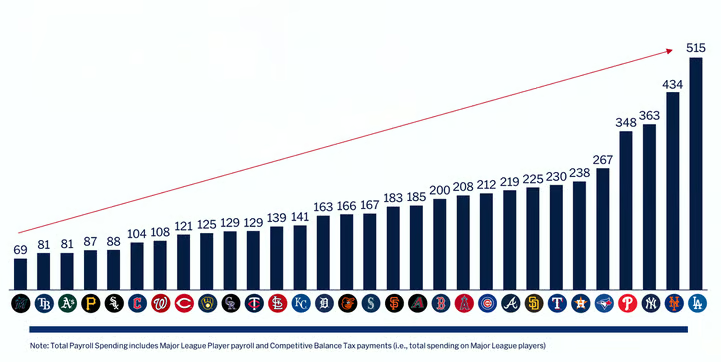
In a significant move aimed at reshaping the economics of Major League Baseball, the league has formally proposed a hard salary cap and floor as part of its initial economic offer to the MLB Players Association for a new Collective Bargaining Agreement. The seven-year deal, which would run from 2027 through 2033, seeks to address what MLB views as the sport’s most pressing competitive issue: the stark payroll disparity that leaves fans in many markets with little hope of seeing their team contend for a World Series title.
Jesse Rogers on X (formerly Twitter): “BREAKING: In its next CBA, the league is proposing a max contract length of 5 yrs for free agent players switching teams, 6 years to retain their own players. No deferred contracts. Qualifying offer is gone too. Also, 5 years to free agency for players 30 or older. / X”
BREAKING: In its next CBA, the league is proposing a max contract length of 5 yrs for free agent players switching teams, 6 years to retain their own players. No deferred contracts. Qualifying offer is gone too. Also, 5 years to free agency for players 30 or older.
The proposal echoes the structure long familiar in the NFL, NBA, and NHL, where salary caps and floors have helped smaller-market franchises compete more effectively. MLB argues that baseball stands alone among major U.S. sports in allowing such vast spending gaps, with the difference between the highest and lowest payrolls reaching a staggering $446 million. Under the new system, no team could exceed the proposed 2027 salary cap of $245.3 million, while every club would be required to meet a $171.2 million floor.
According to league figures, 12 teams—including the Marlins, Guardians, Rays, White Sox, Cardinals, Nationals, Pirates, Twins, Brewers, Athletics, Rockies, and Reds—would need to boost their payrolls by a combined $617 million to reach the floor. On the other end, eight big-market clubs—the Dodgers, Mets, Yankees, Blue Jays, Phillies, Red Sox, Padres, and Braves—would have to trim spending by approximately $578 million to get under the cap. These figures are based on Competitive Balance Tax (CBT) payrolls, which include roughly $23 million per team in benefits.
“Ultimately the game is about hope and competition and too many fans in too many markets have too little hope their team has a fair chance to win,” the league stated. “Fans overwhelmingly support a salary cap and floor like in the other leagues because they don’t believe a $446 million spending gap from top to bottom is a fair fight.”
To sweeten the deal for players, MLB has accepted key MLBPA proposals on free agency. These include earlier access to free agency after years of service and the elimination of the qualifying offer system, which players have long viewed as a hindrance to the open market. The league is also proposing the largest-ever increase in the minimum salary, which benefits over half of all MLB players, along with the elimination of deferred compensation and a new “Cornerstone Player” provision modeled after the NBA’s Bird Rights. This would give teams enhanced flexibility to retain their star players.
On the revenue side, the proposal calls for a straight 50-50 split of baseball revenues between players and owners—aligning MLB more closely with structures in other leagues. Player compensation has lagged revenue growth in recent years (revenues up 247% since 2003, while payrolls rose 149%), and the league promises no reduction in current compensation or benefits, with players set to earn more in aggregate under the new framework. Independent audits would ensure transparency.
Perhaps most notably for fans frustrated by local broadcast issues, the proposal would centralize all local media revenues and share them equally among the 30 teams. This reform aims to tackle blackouts while reducing overall revenue disparity and replacing the current revenue-sharing system, which the union has criticized for disincentivizing growth.
Over the past decade-plus, large-market teams have dominated the postseason landscape, accounting for the vast majority of LCS, World Series, and championship appearances. Only one small-market team (the 2015 Royals) has won it all since 2012, compared to multiple small-market successes in capped leagues like the NFL, NBA, and NHL.
MLB’s proposal frames these changes as essential for long-term growth, allowing the league greater flexibility to address player priorities while fostering genuine competition. “We will continue working with the MLBPA during the bargaining process to improve the game for teams, players and fans,” the statement concludes.
Details are available on MLB’s dedicated “Level the Playing Field” page, which outlines the full vision for a more balanced sport. Whether this ambitious plan gains traction with the union remains to be seen, but it marks a clear opening salvo in what could be transformative negotiations for America’s pastime.
As baseball fans, we’ve all seen the frustration in markets where rebuilding feels perpetual and contention is a distant dream. If MLB can thread this needle—delivering real parity without sacrificing the game’s unique appeal—it could usher in a new era where hope springs eternal in every ballpark, from the smallest markets to the largest. The ball is now in the players’ court.