


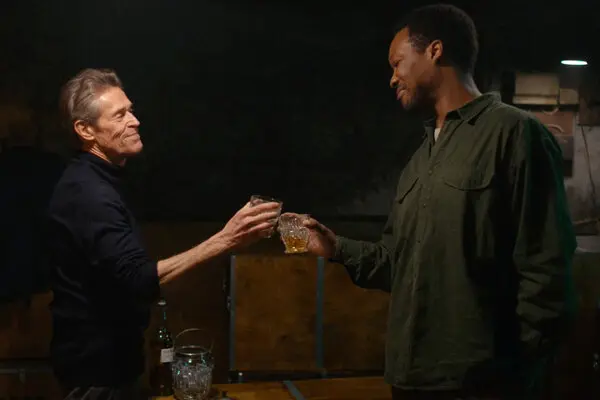
In the quiet, affluent enclave of Sag Harbor, New York, where the ghosts of history linger like fog off the Atlantic, The Man in My Basement unfolds as a slow-burn psychological thriller that promises more than it ultimately delivers. Directed by Nadia Latif in her feature debut, this adaptation of Walter Mosley’s 2004 novel trades the page’s introspective ambiguity for a screen filled with shadows, strained silences, and the weight of unspoken racial reckonings. Clocking in at a deliberate 115 minutes, it’s a film that grips you by the throat in its first act, only to loosen its hold when it matters most.
Corey Hawkins stars as Charles Blakey, a Black everyman adrift in the 1990s—recently orphaned, jobless, and staring down foreclosure on the sprawling family home that’s sheltered eight generations of his lineage. Hawkins brings a raw, coiled vulnerability to Charles, his broad shoulders slumped under the invisible yoke of inherited trauma. Enter Anniston Bennet (Willem Dafoe), a enigmatic white businessman with a clipped European accent and eyes that gleam like polished obsidian. He offers Charles $65,000 in cash to rent the basement for the summer—no questions asked, no keys to the upper floors. Desperation makes fools of us all, and Charles signs on the dotted line, unwittingly inviting a serpent into his garden.
What begins as an uneasy landlord-tenant dynamic spirals into something far more insidious. Bennet transforms the dank basement into a makeshift cell, complete with chains and a one-way mirror, all while probing Charles with Socratic interrogations about power, guilt, and the sins of the fathers. Dafoe is, as ever, magnetic in his menace—charming one moment, predatory the next, his lanky frame slinking through the frame like a spider testing its web. The film’s cinematography, courtesy of Ula Pontikos, turns the house itself into a character: sun-dappled upstairs rooms contrasting the basement’s inky abyss, where shadows swallow secrets whole. Sound design amplifies the dread—creaking floorboards, muffled echoes, the distant hum of ’90s news reports on Rwanda and O.J. Simpson underscoring the era’s racial undercurrents.
Supporting turns add texture without stealing focus. Anna Diop shines as Narciss, a sharp-tongued antique dealer who uncovers African masks in the basement’s detritus, sparking a subplot about cultural reclamation that feels both vital and underdeveloped. Yet for all its thematic ambition—intergenerational trauma, colonial legacies, the commodification of Black pain—the script (co-penned by Latif and Mosley) buckles under its own heft. Subplots multiply like basement damp: Charles’s flirtations, his brother’s looming shadow, historical digressions that veer into lecture territory. The result is a narrative that meanders, building to a finale that’s more whimper than bang—fumbling its scares and resolutions in favor of vague philosophizing.
The Man in My Basement is at its best when it’s intimate and unnerving, a chamber piece where two men circle each other like duelists in the dark. Hawkins and Dafoe generate real electricity, their basement confrontations crackling with the tension of a powder keg. Latif shows real promise as a filmmaker, her clean compositions and atmospheric restraint evoking a modern Get Out lite. But the film’s mixed bag of ideas leaves it feeling overstuffed and underresolved, more conversation starter than knockout punch. Fans of Mosley’s cerebral prose will find echoes worth chasing back to the book; casual thriller seekers might leave frustrated, pondering what lurks unresolved in their own foundations.